If you are unsure whether to write 22th or 22nd, the correct form is 22nd. The number 22 is written as the ordinal twenty second, and its shortened form uses the ending nd.
In this guide, you will learn why 22nd is correct, when to use it and how to avoid common mistakes with dates, birthdays, rankings and other ordinal numbers. Additionally, you will see simple examples that make the difference between 22 and 22nd easy to understand.
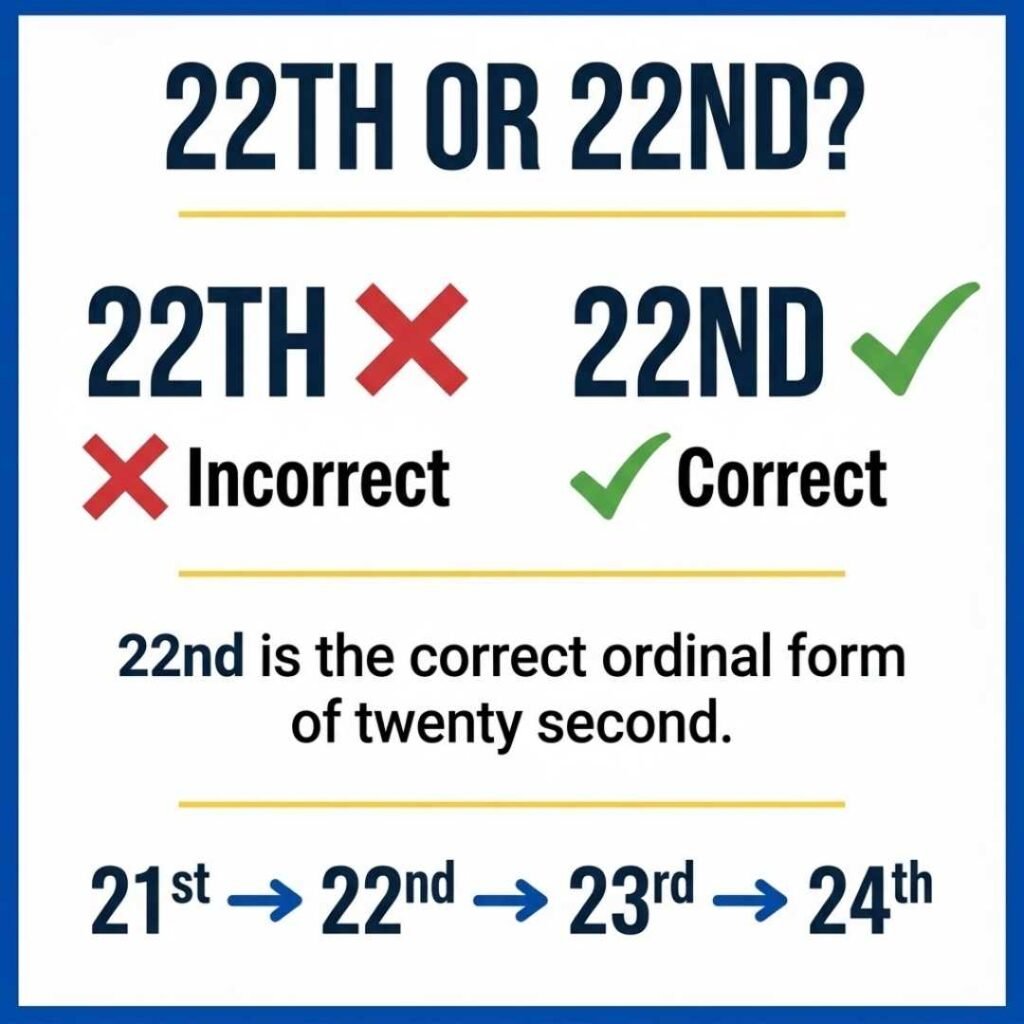
22th or 22nd?
22nd is correct. 22th is incorrect in standard English.
Ordinal numbers show position or order rather than simple quantity. For example, 22 means a quantity of twenty two, while 22nd means position number twenty two. In addition, the Australian Government Style Manual confirms that ordinal numerals use endings such as st, nd, rd and th, with examples including 21st, 32nd and 103rd. Also, these endings help readers understand the position represented by each number. As a result, 22nd clearly shows the twenty second position rather than a quantity of twenty two. Therefore, using the correct ordinal ending makes the meaning clear and follows standard writing conventions.
22th vs 22nd at a Glance
| Context | Correct form | Example | How to tell |
|---|---|---|---|
| Ordinal number | 22nd | the 22nd position | Shows order |
| Date | 22nd | May 22nd | Shows the day |
| Birthday | 22nd | my 22nd birthday | Shows the age milestone |
| Ranking | 22nd | finished 22nd | Shows placement |
| Incorrect form | 22th | 22th birthday | Not standard English |

Why Is 22nd Correct?
The main reason is simple: 22 ends in 2, and ordinal numbers ending in 2 normally use nd.
The basic pattern looks like this:
- 21st = twenty first
- 22nd = twenty second
- 23rd = twenty third
- 24th = twenty fourth
The same pattern continues with larger numbers:
- 32nd = thirty second
- 42nd = forty second
- 52nd = fifty second
- 62nd = sixty second
So when you see 22th, the problem is the ending. The number should follow the ordinal form of second, which gives us 22nd.
What Does 22nd Mean?
22nd is the ordinal form of the number 22. It describes something that comes in position 22 or occurs on the twenty second day of a month.
For example:
She finished 22nd in the competition.
This means 21 people or entries were ahead of her.
You can also use 22nd for a date:
The meeting is on the 22nd of June.
Here, 22nd identifies the twenty second day of June.
The distinction is important because 22 and 22nd do not have the same grammatical job. The first is a cardinal number that tells you how many. The second is an ordinal number that tells you position or order.
When Should You Use 22nd?
You should use 22nd whenever you need the ordinal form of 22.
Dates
The most common use is probably dates.
Examples include:
- June 22nd
- the 22nd of June
- September 22nd
- the 22nd day of the month
Both British and American English use 22nd. The main difference can be the order of the day and month in a date, not the spelling of the ordinal ending.
Birthdays
Use 22nd when describing someone’s twenty second birthday.
For example:
- Happy 22nd birthday!
- She is celebrating her 22nd birthday.
- My 22nd birthday is next month.
- He planned a party for his 22nd birthday.
If you write 22th birthday, the meaning is usually clear, but the form is grammatically incorrect.
Rankings
Ordinal numbers also describe positions in competitions and lists.
Examples:
- She came 22nd in the race.
- Our team finished 22nd overall.
- He was the 22nd person to arrive.
- The book reached 22nd place on the list.
In each case, 22nd tells the reader where something falls in a sequence.
Anniversaries and Milestones
You can also use 22nd for anniversaries and other milestones.
Examples include:
- their 22nd anniversary
- the company’s 22nd year
- the 22nd edition
- the 22nd annual event
Again, 22nd is the correct form.
The Easy Rule for Ordinal Number Endings
A useful way to remember ordinal endings is to look at the final digit.
Numbers ending in 1 usually take st. For example, 1 becomes 1st, 21 becomes 21st and 31 becomes 31st. When a number ends in 2, it usually takes nd, so 2 becomes 2nd, 22 becomes 22nd and 32 becomes 32nd. Similarly, numbers ending in 3 generally take rd, such as 3rd, 23rd and 33rd. For most other endings, the th form is used, such as 4th, 15th and 24th.
- 1st
- 21st
- 31st
- 41st
Numbers ending in 2 usually take nd:
- 2nd
- 22nd
- 32nd
- 42nd
Numbers ending in 3 usually take rd:
- 3rd
- 23rd
- 33rd
- 43rd
Most other numbers take th:
- 4th
- 10th
- 24th
- 25th
- 30th
The Style Manual gives the same basic suffix pattern for ordinal numerals, including 21st, 32nd and 103rd.
Watch Out for 11th, 12th and 13th
There is an important exception to the simple last digit rule.
Numbers ending in 11, 12 and 13 use th, even though their final digits are 1, 2 and 3.
So we write:
- 11th
- 12th
- 13th
Not:
- 11st
- 12nd
- 13rd
This is why you cannot simply look at the final digit every time. You first need to check whether the number ends in 11, 12 or 13.
For 22, there is no exception. Since 22 does not end in 11, 12 or 13, it follows the normal pattern for numbers ending in 2.
Therefore:
22nd is correct.
22nd Birthday or 22th Birthday?
The correct expression is 22nd birthday.
For example:
Happy 22nd birthday!
You can also write the number in words:
Happy twenty second birthday!
The form 22th birthday should be avoided in standard English.
This mistake often happens because many ordinal numbers use th, such as 24th, 25th and 26th. However, numbers ending in 1, 2 or 3 usually have different endings unless they are 11, 12 or 13.
22nd or Twenty Second?
Both forms can be correct, depending on how you are writing the number.
22nd is the numerical form.
twenty second is the written form.
For example:
She finished 22nd in the competition.
Or:
She finished twenty second in the competition.
In everyday writing, 22nd is often shorter and more convenient. In some formal writing styles, numbers may be written out depending on the style guide being followed.
22 or 22nd: What Is the Difference?
The difference between 22 and 22nd is the difference between a cardinal number and an ordinal number.
A cardinal number tells you a quantity:
There are 22 students in the class.
An ordinal number tells you position or order:
She is the 22nd student on the list.
Think of it this way:
22 = how many
22nd = which position
This simple distinction can help you decide whether you need the ordinary number or its ordinal form.
Common Examples of 22nd
Here are some natural examples:
The event will take place on the 22nd of August.
Today is my 22nd birthday.
She finished 22nd in the race.
This is the 22nd chapter of the book.
He was the 22nd person in line.
Our company is celebrating its 22nd anniversary.
The 22nd episode was my favorite.
Each sentence uses 22nd because the number describes a position, date or sequence.
Common Mistakes With 22nd
The most common mistake is adding th simply because it appears in many ordinal numbers.
Mistake 1: Writing 22th
Incorrect:
My birthday is on the 22th.
Correct:
My birthday is on the 22nd.
Mistake 2: Writing 22st
Incorrect:
She came 22st in the competition.
Correct:
She came 22nd in the competition.
The st ending belongs to numbers such as 21st, not 22nd.
Mistake 3: Writing 22rd
Incorrect:
This is his 22rd birthday.
Correct:
This is his 22nd birthday.
The rd ending is used with numbers such as 23rd.
Mistake 4: Confusing 22 With 22nd
Incorrect:
I am celebrating my 22 birthday.
Better:
I am celebrating my 22nd birthday.
The number 22 tells us the age. The ordinal 22nd identifies the birthday milestone.
How to Remember 22nd
A simple memory trick is to connect 22nd with the word second.
The ordinal word for 2 is second. Its abbreviation ends in nd, so numbers ending in 2 generally use the same ending.
Think:
2 → second → 2nd
Then:
22 → twenty second → 22nd
This makes 22th easier to recognize as the wrong form.
Another quick check is to compare nearby numbers:
21st, 22nd, 23rd, 24th
Once you remember this sequence, the correct ending for 22 becomes much easier to recall.
Is 22nd Used in British and American English?
Yes. 22nd is used in both British and American English.
The spelling of the ordinal does not change between these varieties. However, date formatting can differ.
For example, British English commonly uses:
22nd June
American English commonly uses:
June 22nd
The ordinal ending remains nd in both cases.
Can You Write 22th in Casual Texting?
You may see 22th in an informal message because someone has made a spelling mistake. However, it is not the standard form.
If you are writing a birthday card, email, school assignment, invitation, social media post or professional message, use 22nd.
Casual writing does not change the correct ordinal form.
Is “Happy 22nd Birthday” Correct?
Yes. Happy 22nd birthday! is correct.
You can also write:
Happy twenty second birthday!
The first version is more compact, while the second spells out the number.
If you are writing a birthday caption, invitation or greeting card, 22nd birthday is the standard numerical form.
What About 32nd, 42nd and 52nd?
The same pattern applies to other numbers ending in 2.
For example:
- 32nd = thirty second
- 42nd = forty second
- 52nd = fifty second
- 62nd = sixty second
- 72nd = seventy second
The ending remains nd because these numbers end in 2 and do not fall into the 11, 12 or 13 exception.
This pattern makes it easier to remember 22nd without memorizing it as a completely separate rule.
Frequently Asked Questions
Is 22th correct?
No. The standard ordinal form is 22nd, not 22th.
Is 22nd the correct spelling?
Yes. 22nd is the correct numerical form of the ordinal twenty second.
Is it 22nd birthday or 22th birthday?
It is 22nd birthday. The form 22th is incorrect.
Why does 22 use nd?
Because 22 ends in 2, so it follows the ordinal pattern associated with second, giving 22nd.
Is 22nd used in British English?
Yes. British and American English both use 22nd. Date order may differ, but the ordinal ending does not.
Final Answer: 22th or 22nd?
When choosing between 22th or 22nd, always use 22nd in standard English. It is the ordinal form of twenty two and is used for dates, birthdays, rankings, anniversaries and positions in a sequence.
The easiest rule is to remember 21st, 22nd, 23rd and 24th. Since 22 ends in 2, it takes nd, not th. So if you are writing a date or celebrating a 22nd birthday, 22nd is the form to choose.
Source: The Australian Government’s Style Manual explains the standard suffixes used with ordinal numerals.