Canceled or cancelled? Many writers stop and ask this question when they type an email, a notice or a blog post. Both spellings look right, and both appear in print every day.
This article explains which spelling to use, where each one is common and why the difference exists. You will also see how the same rule applies to canceling, cancelling and cancellation.
Both spellings are correct. Canceled, with one L, is the usual American spelling. Cancelled, with two Ls, is the usual British spelling. According to Dictionary.com, cancelled is also preferred in places such as the UK, Ireland, Australia and Canada. Pick the spelling that fits your audience and use it the same way from start to finish.
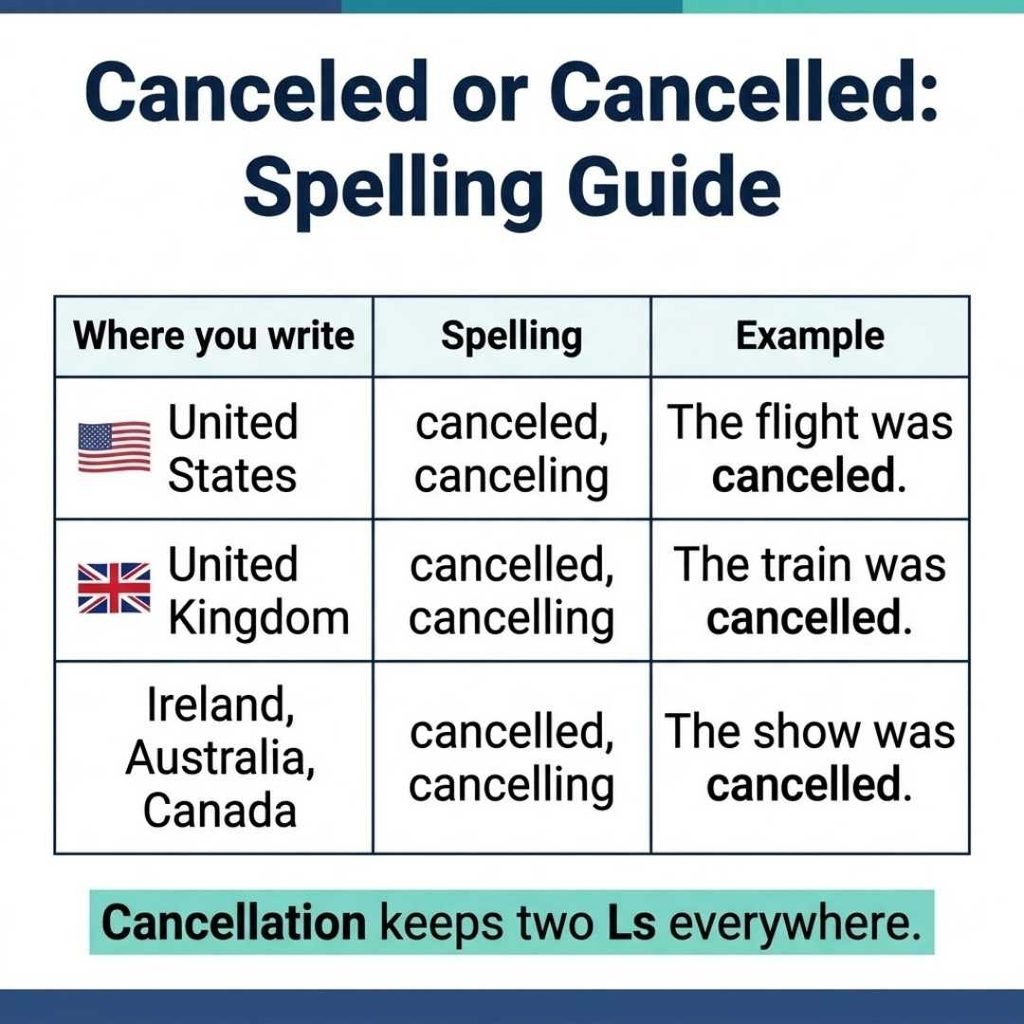
Canceled or Cancelled Spelling Guide at a Glance
| Where you write | Preferred spelling | Example (illustrative) | How to tell |
|---|---|---|---|
| United States | canceled, canceling | The flight was canceled. | Follow American style |
| United Kingdom | cancelled, cancelling | The train was cancelled. | Follow British style |
| Ireland, Australia, Canada | cancelled, cancelling | The show was cancelled. | Dictionary.com lists these as preferred |
| Any country | cancellation | Please confirm the cancellation. | Two Ls in all regions |
| Mixed audience | Choose one and stay consistent | Not applicable | Check your style guide |
What Does Cancel Mean?
Cancel is a verb. It means to stop something that was planned or to mark something as no longer valid. People cancel flights, meetings, orders, subscriptions and bank cards.
Canceled and cancelled are both the past tense and the past participle of cancel. They sound the same and mean the same. Only the spelling changes.
Here is how the two forms work in a sentence. In “I canceled the meeting,” the word is a simple past tense verb. In “The meeting was canceled,” the word is a past participle that follows “was.”
The same pattern holds for the other spelling. You can write “I cancelled the meeting” or “The meeting was cancelled” with no change in meaning.
Canceled or Cancelled Around the World
The spelling you pick depends mostly on who will read your text. Readers rarely mind either form, but a consistent choice looks more polished.
American English
In the United States, canceled and canceling are the typical forms. Merriam-Webster says the one L version is more common in American English and the two L version is more common in British English. It also says that either spelling is fine.
You will still see cancelled in American writing. Some publications and businesses use it, and nobody would call it a mistake. It is simply the less common choice in the US.
British English
In British English, cancelled and cancelling are the standard forms. A British reader may find canceled unusual, but the meaning stays clear.
This choice fits a wider pattern in British spelling. Writers double a final L when they add an ending such as ed or ing. You will see the pattern again in the doubling rule below.
Canada, Australia and Ireland
Dictionary.com says cancelled is preferred in many places outside the United States. It names the UK, Ireland, Australia and Canada. If your readers live in one of these countries, two Ls is the safer pick.
Other English speaking countries often follow British habits too. Still, local style guides differ. If you write for a company or a publisher, check their house rules before you decide.
Why Canceled and Cancelled Differ
The difference goes back to dictionaries. British spelling largely followed Samuel Johnson’s dictionary from 1755. American spelling took shape with Noah Webster’s dictionary from 1828, as Dictionary.com explains.
Webster gets a lot of credit and blame for American spellings. Merriam-Webster points out that he often recorded variations that already existed. His 1806 dictionary lists cancelled, while his 1828 dictionary lists canceled.
That detail shows the change was gradual. Both forms lived side by side for a long time. Over the years, each country leaned toward one of them.
Merriam-Webster also reminds readers that both forms appear in both countries. You can find cancelled in American use and canceled in British use. So a slip is not a reason to worry.
English spelling is a mix of old habits, reform efforts and plain accident. This word is a small example of that mix.
The Doubling Rule Behind the Extra L
Many English verbs end in a single L. When you add ed or ing, British English usually doubles the L. American English usually keeps one L.
Dictionary.com gives several pairs that show this pattern. In American English, you write traveled, labeled, signaled and fueled. In British English, you write travelled, labelled, signalled and fuelled.
Cancel follows the same rule. American English gives canceled and canceling. British English gives cancelled and cancelling.
This rule has a useful side effect. If you write canceled, you should also write traveled and labeled for the sake of consistency. If you write cancelled, match it with travelled and labelled.
Some verbs break the pattern in both countries. Compel and rebel become compelled and rebelled in American and British English alike. The stress falls on the last syllable of those verbs, so the L doubles everywhere. Cancel puts the stress on the first syllable, which is why the two countries part ways.
Related Forms: Canceling, Cancelling and Cancellation
The one L and two L split carries into the ing form. Americans write canceling. Britons write cancelling.
Cancellation is the exception. Merriam-Webster says it is the usual spelling everywhere, even though cancelation appears now and then. If you want a safe choice, use cancellation with two Ls.
Other forms follow the same regional split. Canceler and canceller, or cancelable and cancellable, depend on the style you choose. Keep them in line with your main spelling.
A simple rule helps here. In the US you write one L before the ending. In the UK you write two Ls before the ending. The noun cancellation always keeps two.
Does the Spelling Change the Pronunciation?
No. Canceled and cancelled sound the same when you say them aloud. The stress falls on the first syllable, and the second syllable stays short and light.
This is why spelling mistakes with this word are so easy to make. Your ear gives you no clue. You must rely on the regional rule, a dictionary or your style guide.
The same holds for canceling and cancelling. Both forms sound identical in speech, so the choice only matters on the page or the screen.
For learners of English, this is good news. You can speak the word with confidence and decide on the spelling later, once you know your audience.
Canceled in Cancel Culture and Social Media
In recent years, canceled has gained a social meaning. When people say a public figure got canceled, they mean the person lost public support. Grammar Monster notes that this newer sense has appeared especially in social media and popular culture.
The spelling rule does not change in this sense. An American writer would say a celebrity got canceled. A British writer would say a celebrity got cancelled.
This meaning is informal, and context makes it clear. If someone says a show was canceled, they usually mean the network stopped it. If someone says a person was canceled, they mean a loss of public support.
Be careful in formal writing. A reader may not expect the social meaning in a news report or a legal notice. Use plain words such as “withdrew support” if you need to be precise.
Canceled and Cancelled in Sentences
These examples are illustrative. They show how the same sentence looks in each style.
American English
- The airline canceled my flight because of the storm.
- We are canceling our dinner plans tonight.
- She canceled her gym membership last week.
British English
- The airline cancelled my flight because of the storm.
- We are cancelling our dinner plans tonight.
- She cancelled her gym membership last week.
Notice that only the L changes. The grammar, the tone and the meaning stay the same. The noun stays the same too, so “I need to confirm the cancellation” works in both countries.
You can also use the word in a figure of speech. A bank cancels a check, and one factor cancels out another. Both uses follow the same spelling rule.
Where You See Canceled and Cancelled in Daily Life
The word shows up in many everyday settings. Knowing them helps you spot the right spelling quickly.
Travel and events
Airlines, rail companies and event teams use the word all the time. A traveler in the US may read “Your flight was canceled” on an app. A traveler in the UK may read “Your train has been cancelled” on a station board.
Shopping and subscriptions
Stores and streaming services send notices when you stop an order or a plan. An American store may write “Your order was canceled.” A British store may write “Your order was cancelled.” The refund steps that follow stay the same.
Media and entertainment
Television networks and streaming platforms often end a show early. Fans then say the show was canceled or cancelled, depending on their country. Both spellings appear in entertainment news every day.
Banking and paperwork
Banks mark a check as canceled when it can no longer be cashed. They also cancel cards that are lost or stolen. In each case, the spelling follows the style of the bank or the publisher.
Canceled Compared With Similar Words
Writers sometimes pick the wrong word, not the wrong spelling. Several terms sound close to canceled, yet they mean something different.
Postponed means the event will happen later. Rescheduled means the event has a new date or time. Delayed means the event starts late but still goes ahead.
Called off is a casual way to say canceled. It often appears in speech and in headlines. Voided is stronger and usually applies to contracts, tickets or checks that no longer count.
Choose the word that matches the facts. If a concert moves to next month, do not say it was canceled. Say it was postponed or rescheduled. This keeps your readers from making wrong plans.
Tips for Writers and Editors
If you manage a lot of text, a few habits save time. First, write a short style sheet that lists your spelling choices. Add canceled or cancelled to the list, along with other words that differ by region.
Second, search your document before you publish it. Look for both spellings and make sure only one appears. A quick find and replace can fix a mismatch in seconds.
Third, check names and quotes with care. If a brand or a person uses a certain spelling, keep it in the original quote. Change only your own wording.
Fourth, remember that titles and headings count too. A mixed spelling in a heading looks careless because readers see it first.
Finally, ask a colleague from your target region to read key pages. A local reader can spot small spelling habits that a tool may miss.
Common Mistakes to Avoid
The biggest mistake is mixing both spellings in one document. A reader who sees canceled in the first paragraph and cancelled in the third may think you made an error. Pick one form and stay with it.
Another mistake is thinking that the noun must match the verb. Cancellation keeps two Ls even when you write canceled. This is normal and correct.
Some writers also assume that one spelling is simply wrong. That is not true. As noted earlier, both forms are acceptable, and each is more common in a different region.
A last mistake comes from spell checkers. If your software is set to the wrong language, it may flag a correct word. Set the language to match your audience, and the warning will go away.
How to Choose the Right Spelling for Your Work
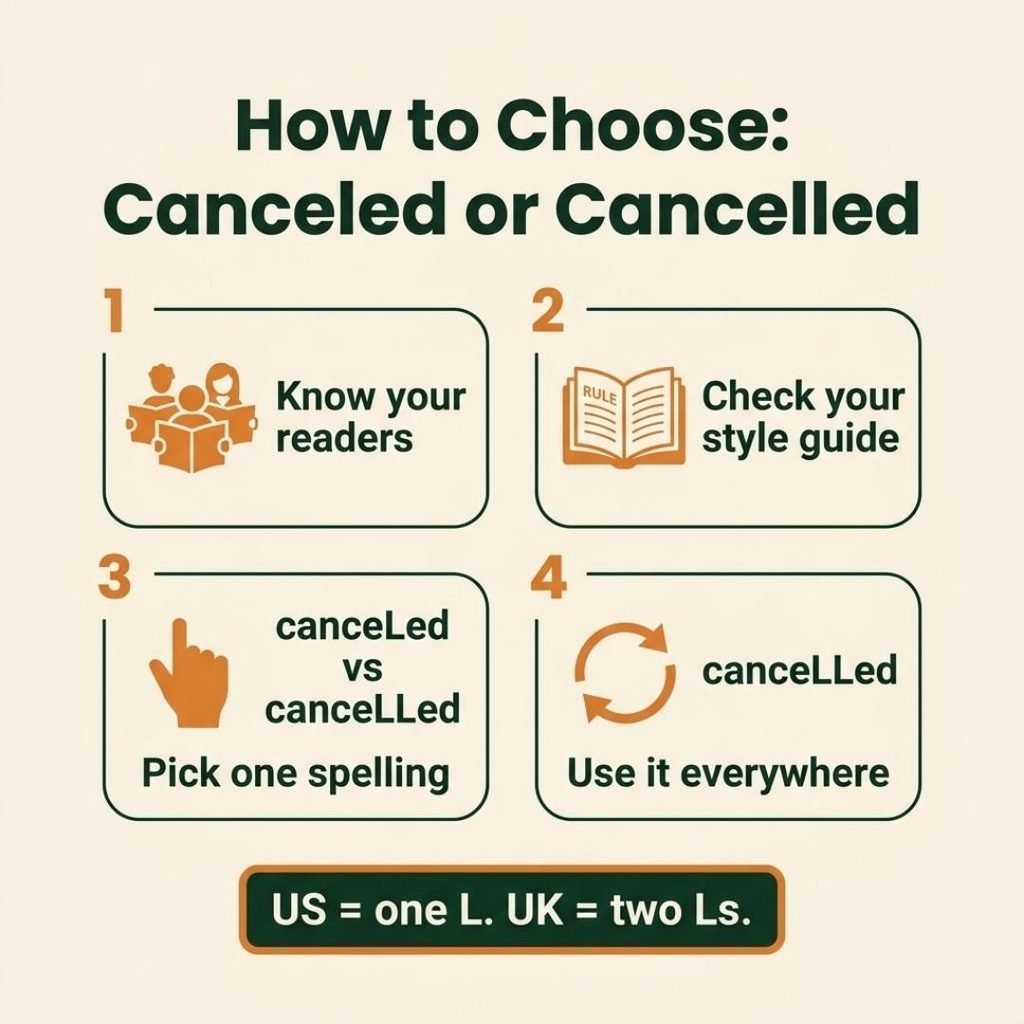
Start with your readers. If most of them live in the United States, use canceled. If most live in the UK or another country that prefers British spelling, use cancelled.
Next, check any style guide you must follow. A company, a school or a publisher may have a rule already. Follow that rule even if you prefer the other form.
Then think about your whole page. Use the same spelling in the title, the headings, the body and the meta text. Consistency helps readers trust your writing.
Finally, keep a simple memory trick in mind. The United States uses one L. The United Kingdom uses two Ls. That small rule covers most cases.
Keep in mind that readers may type either spelling when they search for help. A page that explains both forms, like this one, serves both groups. Your regular posts and notices, however, should still use only one form.
Also consider where your content will travel. A message sent to a global team may reach readers in many countries. In that case, a note in your style sheet about your chosen spelling will keep everyone on the same page.
If your audience is mixed, choose the spelling used by the majority and move on. Few readers will notice the difference, and none will misunderstand you.
FAQs About Canceled or Cancelled
Is it canceled or cancelled?
Both are correct. Use canceled in American English and cancelled in British English. The meaning is the same in both forms.
Is cancelled wrong in American English?
No. Cancelled is less common in the US, but it is not an error. Just keep one spelling throughout your text.
Which spelling do Canada and Australia use?
Dictionary.com lists cancelled as the preferred spelling in both countries. Check any local style guide you must follow.
Is cancellation spelled with one L or two?
Merriam-Webster says cancellation with two Ls is the usual spelling everywhere. Cancelation appears sometimes, but it is less common.
Does the meaning change with the spelling?
No. Canceled and cancelled mean the same thing. Only the regional spelling differs.
Conclusion
Canceled and cancelled are two correct spellings of the same word. One L suits American English, and two Ls suit British English and many other regions. Choose the form that matches your readers and keep it consistent.
When you are unsure, remember the simple rule. The United States uses one L, and the United Kingdom uses two. The word cancellation keeps two Ls everywhere.