Have you ever wondered whether suing or sueing is the correct spelling? The confusion is understandable because the base verb is “sue” and it can look natural to add “ing” without changing the word.
The correct spelling is suing. In this guide you will learn what suing means, why “sueing” is incorrect in standard English and how to use the correct form in everyday and legal sentences.
Suing or Sueing?
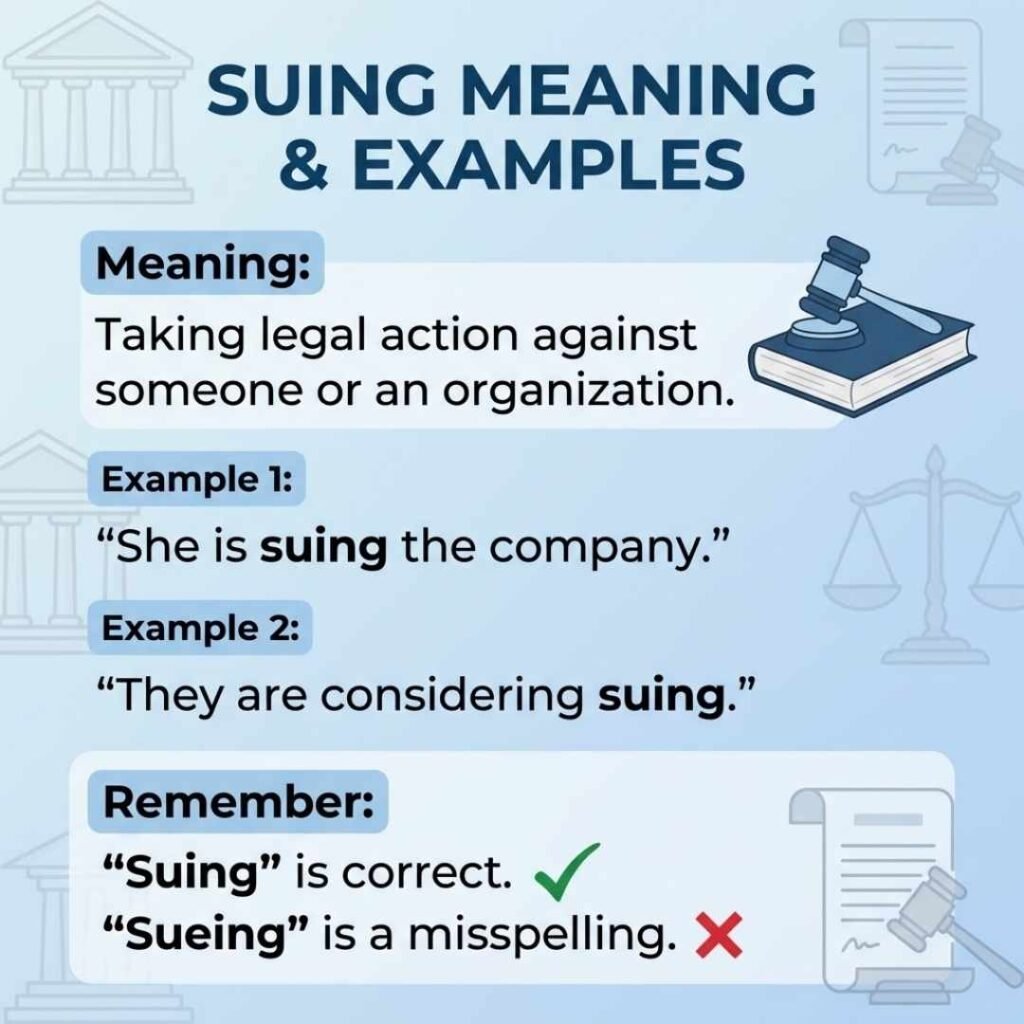
Suing is the correct spelling. Sueing is a misspelling in standard English.
“Suing” is the present participle of sue. The verb “sue” means to take legal action against a person or organization. Cambridge Dictionary defines suing as the present participle of “sue” and explains that suing can involve making a legal claim because of harm caused by another person or organization.
So the correct form is:
sue → suing
Not:
sue → sueing
| Context | Correct form | Example | How to tell |
|---|---|---|---|
| Present action | Suing | She is suing the company. | Use “suing” |
| Future possibility | Suing | They may consider suing. | Use “suing” after “consider” |
| Legal action | Suing | He is suing for damages. | Refers to legal action |
| Incorrect spelling | Sueing | She is sueing him. | Replace it with “suing” |

What Does Suing Mean?
Suing means taking legal action against someone or an organization. It comes from the verb sue.
For example:
She is suing the company for damages.
This means she has started or is taking legal action against the company to seek a legal remedy.
The word can also describe a legal action that someone is considering:
They are thinking about suing their landlord.
Here “suing” describes the possible legal action they are considering.
The exact legal process can vary depending on the type of claim and the jurisdiction. However the basic meaning of the word remains the same: taking legal action against someone through the legal system.
You can also find “suing” used as a noun like gerund in a sentence:
Suing the company could take time.
Here “suing” refers to the act of taking legal action.
Why Is Suing Correct?
The spelling becomes easier to understand when you look at the base verb.
The base verb is:
sue
When “ing” is added the final silent e is removed:
sue + ing = suing
This is a common English spelling pattern. Similar changes appear in words such as:
make → making
write → writing
use → using
drive → driving
The same basic pattern gives us:
sue → suing
The spelling can look unusual because “suing” contains the letters u and i together. However the word is still pronounced with the sound associated with “sue” followed by “ing.”
Dictionary.com also identifies “suing” as the present participle of “sue” and defines “sue” as bringing a civil legal action against someone.
Why Do People Write Sueing?
The spelling sueing looks logical at first because people often form an “ing” word by attaching the ending to the base verb.
For example:
play → playing
work → working
help → helping
Someone who starts with “sue” may therefore write:
sue + ing = sueing
However English spelling does not always work by simply adding the ending. In this case the final e is removed.
That gives:
sue → suing
So “sueing” does not represent a different meaning. It is simply the spelling people may use when they apply the wrong pattern.
Is Sueing Ever Correct?
In standard modern English writing, sueing is not the accepted spelling of the “ing” form of “sue.”
If you mean taking legal action use suing.
For example:
Correct: The customer is suing the company.
Incorrect: The customer is sueing the company.
Correct: She is considering suing her former employer.
Incorrect: She is considering sueing her former employer.
The intended meaning may still be obvious when someone writes “sueing.” However the spelling should be corrected in formal writing.
Suing Meaning in Different Sentences
The word “suing” can appear in several sentence structures.
Suing someone
This structure identifies the person or organization facing legal action.
The employee is suing the company.
The sentence says that the employee is taking legal action against the company.
Suing for damages
This structure describes a claim involving damages.
The customer is suing for damages.
The sentence indicates that the person is seeking damages through legal action.
Considering suing
“Suing” can follow verbs such as “considering.”
They are considering suing the contractor.
This does not necessarily mean that the lawsuit has already been filed. It says they are considering legal action.
Threatening to sue
The word can also appear after “threatening.”
He is threatening to sue the newspaper.
This means he has threatened legal action. It does not by itself establish that a lawsuit has been filed.
Suing Examples in Everyday English
Here are some simple examples to show how suing works in context:
She is suing the company over the dispute.
The family is suing for damages.
He is considering suing his former employer.
The customer threatened to sue the business.
They discussed whether suing would be necessary.
The company is being sued by a former employee.
She decided against suing after reaching an agreement.
The lawyer explained what could happen if they started suing.
These examples show why context matters. “Suing” always relates to the verb “sue” and therefore to legal action.
Suing vs Sueing: What Is the Difference?
There is no separate meaning that distinguishes suing from sueing.
The important difference is spelling.
Suing is the standard form.
Sueing is a misspelling.
Both may be intended to refer to the same action but only suing should be used in standard English writing.
This distinction matters more in formal settings such as school assignments, professional emails, reports and legal writing. In casual messages a reader may understand “sueing” from context but that does not make the spelling correct.
Is Suing a Verb or a Noun?
“Suing” can work as the present participle of the verb “sue.” It can also function as a gerund, which is an “ing” form that acts like a noun.
As a verb:
The company is suing its supplier.
Here “suing” forms part of the verb phrase “is suing.”
As a gerund:
Suing the supplier may be expensive.
Here “suing the supplier” functions as the subject of the sentence.
The spelling stays the same in both cases.
Common Mistakes With Suing
Writing Sueing
The most common mistake is adding “ing” directly to “sue.”
Incorrect:
She is sueing the company.
Correct:
She is suing the company.
Thinking Sueing Has a Different Meaning
Some people may assume that “sueing” and “suing” have different meanings. They do not.
“Sueing” is not a separate legal term. It is a misspelling of “suing.”
Confusing Suing With Sued
“Suing” and “sued” are different forms of the same verb.
Suing describes an ongoing action or an action being considered.
She is suing the company.
Sued is the past form.
She sued the company last year.
The spelling changes because the grammatical form changes.
Confusing Suing With Sue
“Sue” is the base form.
They plan to sue the company.
“Suing” is the “ing” form.
They are suing the company.
Both are correct when used in the right grammatical structure.
How to Remember the Correct Spelling
A simple way to remember it is:
sue → remove e → suing
Think of the final e as disappearing before “ing” is added.
You can compare it with familiar words:
make → making
write → writing
use → using
sue → suing
This makes the spelling easier to recall when you need it quickly.
Another useful trick is to remember that “sueing” does not create a new meaning. If you are talking about legal action and need the “ing” form of “sue,” the word you want is suing.
Is Suing Used in Formal Writing?
Yes. Suing is a standard English word and appears in legal discussions as well as general writing.
For example:
The company is suing the contractor.
The family is suing for damages.
The newspaper reported that the group was suing the organization.
However legal writing can involve precise terms that depend on the jurisdiction and type of case. If you are preparing an actual legal document you should use the terminology appropriate to your jurisdiction rather than relying only on a general English spelling guide.
For the spelling question itself the answer is straightforward: use suing, not “sueing.”
What Is the Pronunciation of Suing?
“Suing” is generally pronounced like “SOO ing.”
The pronunciation is closely related to the base word “sue.”
You can think of it as:
sue + ing → suing
The spelling may look slightly unusual but the pronunciation is not difficult once you recognize the two parts.
Can You Use Suing in a Text Message?
Yes. You can use “suing” in casual messages whenever you are talking about legal action.
For example:
Are they actually suing the company?
She said she was thinking about suing.
I heard he is suing his former employer.
The word itself is not slang. It is a standard English form of the verb “sue.”
Because legal issues can be serious, however the surrounding message should make clear whether someone is actually taking legal action or simply talking about the possibility.
What Does “Considering Suing” Mean?
“Considering suing” means thinking about the possibility of taking legal action.
It does not necessarily mean that a lawsuit has already been filed.
For example:
The customer is considering suing the company.
This tells us that legal action is being considered. It does not by itself confirm that a case has started.
This distinction is useful because people sometimes use legal words loosely in conversations. The exact status of a case requires more information.
What Does “Being Sued” Mean?
“Being sued” means that someone is the target of legal action.
For example:
The company is being sued by a customer.
Here the company is the party facing the legal claim.
Compare the two structures:
The customer is suing the company.
The company is being sued by the customer.
Both sentences describe the same basic legal situation from different perspectives.
Frequently Asked Questions
Is suing the correct spelling?
Yes. Suing is the standard spelling of the present participle and gerund form of “sue.”
Is sueing a word?
“Sueing” is not the standard spelling of the “ing” form of “sue.” Use suing instead.
What does suing mean?
Suing means taking legal action against a person or organization through the legal system.
How do you spell sue with ing?
Spell it suing. The final “e” in “sue” is removed before “ing” is added.
Is suing the same as being sued?
No. “Suing” describes taking legal action while “being sued” describes the person or organization facing that action.
Final Takeaway
When choosing between suing or sueing, the correct spelling is suing. It is the “ing” form of sue and refers to taking or considering legal action.
The easiest rule to remember is simple: sue becomes suing. If you see “sueing” in your writing, replace it with suing.
Pingback: Canceled or Cancelled: Which Spelling Is Right for You? - Centowise