If you are unsure whether to write absence or absense, you are dealing with a common spelling confusion. Only one form is correct in standard English.
The correct spelling is absence. In this guide, you will learn what absence means, why absense is incorrect, how to use absence in sentences and how to remember the spelling.
Absence or Absense?
Absence is the correct spelling. Absense is a misspelling and should not be used in standard English.
The word absence is a noun that means the state of being away or not present. It can also describe the lack or nonexistence of something. Cambridge Dictionary gives both meanings and provides examples such as absence from work and the absence of evidence.
| Context | Correct form | Example | How to tell |
|---|---|---|---|
| Person not present | Absence | Her absence was noticed. | Someone is not there |
| Missing from work | Absence | His absence from work was recorded. | The person is away |
| Something missing | Absence | There was an absence of evidence. | Something does not exist |
| Incorrect spelling | Absense | Avoid this spelling. | It uses s instead of c |
What Does Absence Mean?
Absence means the state of not being present in a place where someone or something is expected to be.
For example:
Her absence from the meeting was noticed.
Here, absence refers to the fact that she was not at the meeting.
The word can also describe something that is missing or does not exist. For example:
The absence of evidence made the decision difficult.
In this sentence, absence means that evidence was not available.
Cambridge Dictionary lists both uses. It defines absence as not being where someone is expected to be and also as the fact that something does not exist.

Why Is Absence Correct and Absense Wrong?
The correct spelling is absence, with a c before the final e.
The incorrect form absense replaces the c with an s. Although absense may look reasonable when you hear the word, it is not the standard spelling.
The confusion happens because absence and absense can sound very similar. The sound does not clearly tell you whether the spelling should contain c or s.
English also contains many words ending in ence and ense. That can make the choice harder when you are writing quickly.
The safest rule is simple:
Always write absence with c.
Absence or Absense: Which One Should You Use?
Use absence in every standard English context.
You should write absence in:
- School assignments
- Exams
- Business emails
- Workplace documents
- Formal letters
- Reports
- Social media posts
- Everyday messages
There is no need to change the spelling for British or American English. The standard spelling is absence in both varieties.
For example:
Correct: The teacher asked about my absence.
Incorrect: The teacher asked about my absense.
Correct: Her absence was unexpected.
Incorrect: Her absense was unexpected.
If you are writing for school or work, absence is the form you should choose.
Common Examples of Absence
Understanding the word in real sentences makes the spelling easier to remember.
Absence From School
When a student does not attend school, you can use absence to describe the situation.
The teacher recorded his absence from school.
She explained the reason for her absence.
Several absences affected his attendance record.
Cambridge Dictionary also uses absence when discussing repeated absences from school and work.
Absence From Work
The word is also common in professional situations.
Her absence from work was unexpected.
The manager handled the project during his absence.
Please inform your supervisor about any planned absence.
The phrase leave of absence is also commonly used when someone receives permission to be away from work or another regular responsibility. Cambridge lists this as a common expression with absence.
Absence of Something
Absence does not only describe people who are away. It can also describe something that is missing.
The absence of clear instructions caused confusion.
There was an absence of evidence.
The room had an unusual absence of natural light.
This use is especially common in formal and academic writing.
Common Phrases With Absence
Learning common phrases can help you remember the correct spelling.
In the Absence of
In the absence of means while something is not present or because something is unavailable.
For example:
In the absence of further information, we waited.
In the absence of proof, the claim could not be confirmed.
Cambridge explains that this phrase can refer to something or someone not being present or not existing.
In Someone’s Absence
In someone’s absence means while that person is away or not present.
For example:
She made the decision in his absence.
I will manage the office in your absence.
This phrase is useful in both everyday and professional English.
Leave of Absence
A leave of absence is a period when someone is officially allowed to be away from work or another responsibility.
For example:
She took a leave of absence from work.
Absence From
The phrase absence from identifies the place or activity someone did not attend.
For example:
His absence from class was noticed.
Her absence from the meeting caused a delay.
Absence vs Absent
Another common question is whether to use absence or absent.
The two words are related but have different grammatical roles.
Absence is a noun. It names the state or fact of not being present.
His absence was unexpected.
Absent is usually an adjective. It describes someone or something that is not present.
He was absent from class.
A simple way to remember this is:
Absence = the condition
Absent = the description
Cambridge lists absent as the related adjective and gives examples showing how it describes someone who is not present.
What Is the Plural of Absence?
The plural form of absence is absences.
For example:
The school recorded three absences this month.
Frequent absences can affect attendance records.
The plural is formed by adding s to absence, giving absences. Cambridge also lists absences as the plural form.
Notice the spelling:
Singular: absence
Plural: absences
Do not change the c to an s when making the plural.
Why Do People Spell Absence as Absense?
The main problem is the sound.
When spoken, the ending of absence does not strongly reveal the letter c. Someone who is spelling the word from sound may therefore choose s instead.
The incorrect spelling can also look familiar because English has many words containing sense or ending in ense.
That does not make absense an accepted spelling. It simply explains why the error can feel natural.
When you are unsure, remember the correct sequence:
A B S E N C E
The c comes before the final e.
Easy Trick to Remember the Spelling
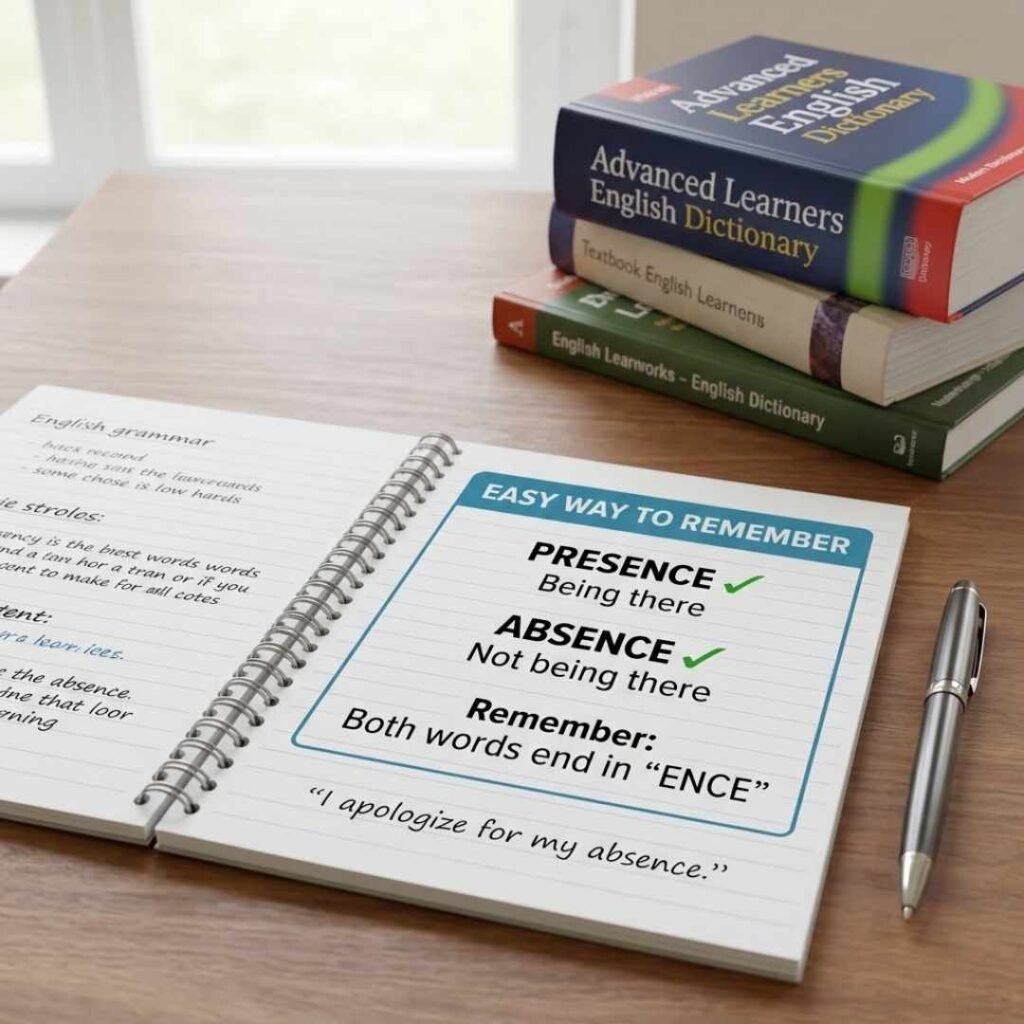
A useful memory trick is to connect absence with presence.
These two words are opposites:
Presence = being there
Absence = not being there
Both end in ence.
So when you remember presence, let it remind you that absence also has a c.
You can also remember this short rule:
Absence has a c. Absense is incorrect.
Writing the two words side by side can make the difference clear:
absence ✓
absense ✗
Absence in Formal and Everyday Writing
The word absence works in both formal and casual English.
Formal writing often uses the word absence in clear and professional sentences. For example, you might see:
The absence of reliable data limits the conclusion.
Another example is:
The absence of clear instructions caused confusion.
You may also find the word in workplace or academic writing when describing something that is missing or unavailable.
The absence of reliable data limits the conclusion.
Workplace writing often uses absence in professional situations. For example:
Please notify your manager about your absence.
A manager may also write, “Her absence from work was unexpected.” Another common phrase is “in your absence,” which means while you are away.
Please notify your manager about your absence.
In school writing, you might see:
The student explained his absence from class.
In everyday conversation, you might say:
I noticed your absence yesterday.
The meaning stays the same. Only the surrounding language changes with the situation.
Common Mistakes to Avoid
The most important mistake is writing absense instead of absence.
Here are some examples:
Wrong: I apologize for my absense.
Right: I apologize for my absence.
Wrong: Her absense from school was unusual.
Right: Her absence from school was unusual.
Wrong: The absense of evidence created doubt.
Right: The absence of evidence created doubt.
Another mistake is confusing absence with absent.
Wrong: His absent was noticed.
Right: His absence was noticed.
Right: He was absent from the meeting.
Remember that absence is a noun while absent is normally an adjective.
Is Absense Ever Correct?
No. Absense is not the standard English spelling of this word.
If you mean the state of being away or the lack of something, use absence.
For example:
Her absence was obvious.
Not:
Her absense was obvious.
You may encounter the incorrect spelling online, but seeing a spelling repeatedly does not make it a standard English form.
Absence or Absense in British and American English
There is no British versus American spelling difference for these two forms.
Both British English and American English use absence.
| English variety | Correct spelling |
|---|---|
| British English | absence |
| American English | absence |
| Standard English | absence |
| Incorrect form | absense |
This is different from words that genuinely have regional spelling differences. You do not need to choose between absence and absense based on your audience.
How to Pronounce Absence
Absence is pronounced approximately like AB suhns.
Cambridge gives the UK pronunciation as /ˈæb.səns/ and the US pronunciation as /ˈæb.səns/.
The similar sound is one reason the spelling can cause confusion. When you hear the word, the pronunciation does not make the written c obvious.
That is why remembering the written form is more useful than trying to spell it entirely by sound.
Absence and Its Related Words
Several words belong to the same word family.
Absence: the state of not being present
Absent: not present
Absentee: someone who is not present when expected
Absenteeism: repeated or habitual absence, especially from work or school
For example:
Her absence was noticed.
She was absent yesterday.
He was the only absentee at the meeting.
Cambridge defines an absentee as someone who is not at school or work when they should be.
Knowing these related forms can help you use the word correctly without confusing their grammatical roles.
Frequently Asked Questions
Is it absence or absense?
Absence is correct. Absense is a misspelling.
What does absence mean?
Absence means being away or not present. It can also mean that something does not exist or is missing.
Is absence spelled with c or s?
It is spelled with c: absence.
What is the plural of absence?
The plural is absences.
Is absense a British spelling?
No. British and American English both use absence.
Conclusion
The answer to absence or absense is simple: absence is the correct spelling. It means the state of being away or the lack of something.
If you often confuse the two forms, remember the pair presence and absence. Both use ence with a c. Once you remember that pattern, you can avoid the common absense spelling mistake in schoolwork, emails and everyday writing.
For reliable definitions and usage examples, see the Cambridge Dictionary entry for absence.
Pingback: 22th or 22nd: Which Is Correct? - Centowise
Pingback: Chello or Cello: Which Spelling Is Correct? - Centowise
Pingback: Transfered or Transferred: Which Spelling Should You Use? - Centowise
Pingback: Helpped or Helped: Which Spelling Is Correct in English? - Centowise