Transfered or transferred? Many writers pause on this word when they write about money, jobs, schools or files. The two spellings look alike, but only one of them is correct.
This article gives a clear answer and explains the rule behind it. You will also see examples, related word forms and simple tips to avoid the mistake.
Transferred, with two Rs, is the correct spelling. Transfered, with one R before the ending, is a common misspelling. Merriam-Webster lists transferred and transferring as the verb forms of transfer. The same rule applies in American and British writing.
Transfered or Transferred Spelling Guide at a Glance
| Word form | Correct spelling | Example (illustrative) | How to tell |
|---|---|---|---|
| Base verb | transfer | I will transfer the files. | No ending added |
| Past tense | transferred | She transferred the money. | Double the R before ed |
| Past participle | transferred | The call was transferred. | Same as past tense |
| Ing form | transferring | He is transferring schools. | Double the R before ing |
| Noun | transfer | The transfer went smoothly. | One R, no ending |
| Common error | transfered | Not correct in any context | Missing the second R |
What Does Transfer Mean?
Transfer is a verb that means to move something from one place, person or situation to another. It can also mean to hand over control or ownership. Merriam-Webster lists several senses of the word, and all of them involve a change of place, hands or form.
In everyday life, people use it in many ways. A hospital can move a patient to another hospital. A company can move an employee to a new office. A student can leave one school and enroll at another.
The word also works for things you cannot touch. You can transfer data from one drive to another. You can also transfer a skill from one job to the next. Merriam-Webster even lists a use for printing a design from one surface to another.
As a noun, transfer names the act itself or the person or thing that moves. You might ask for a transfer to another team. You might also take a transfer from one bus line to another. Merriam-Webster says the word has been in use since the 14th century.
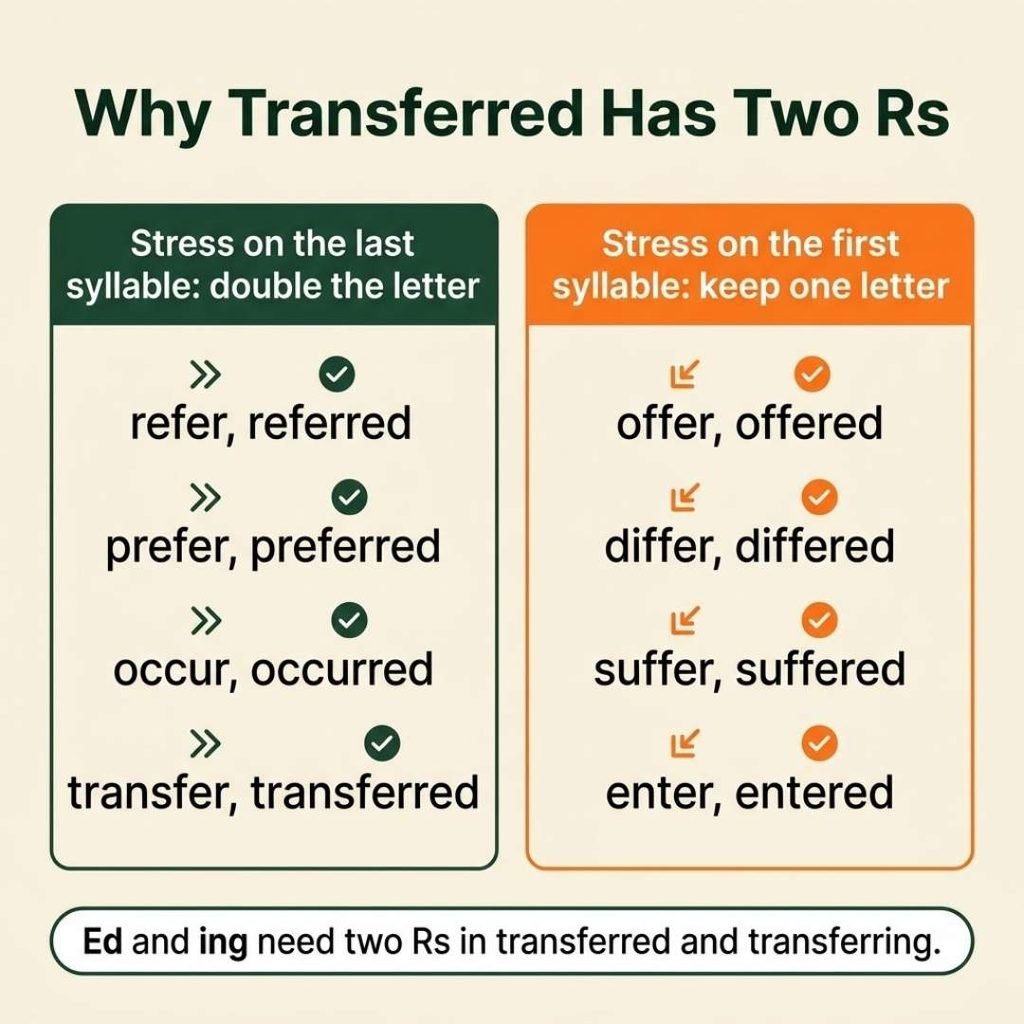
Why Transferred Has Two Rs
The second R comes from a common spelling rule. When a verb ends in a stressed syllable with one vowel and one consonant, you double the consonant before ed or ing. Transfer follows this rule.
Say the verb aloud. The stress falls on the second syllable, so you hear trans-FER. Because that last syllable carries the stress, the R doubles when you add an ending. That gives you transferred and transferring.
Merriam-Webster shows the verb with this stress pattern. The noun is different, since the stress moves to the first syllable. Still, the noun keeps one R because you add no ending to it.
Other verbs that follow the same rule
Many common verbs work the same way. Refer becomes referred and referring. Prefer becomes preferred and preferring. Occur becomes occurred and occurring.
Defer becomes deferred. Confer becomes conferred. Infer becomes inferred. Each verb ends in a stressed syllable, so each one doubles the final consonant.
Verbs that do not double
Some verbs end in a syllable that carries no stress. These verbs do not double the final consonant. Offer becomes offered. Differ becomes differed. Suffer becomes suffered.
Enter becomes entered, and gather becomes gathered. If you mix up the two groups, you can end up with a wrong spelling. Stress is the clue that tells you which group a verb belongs to.
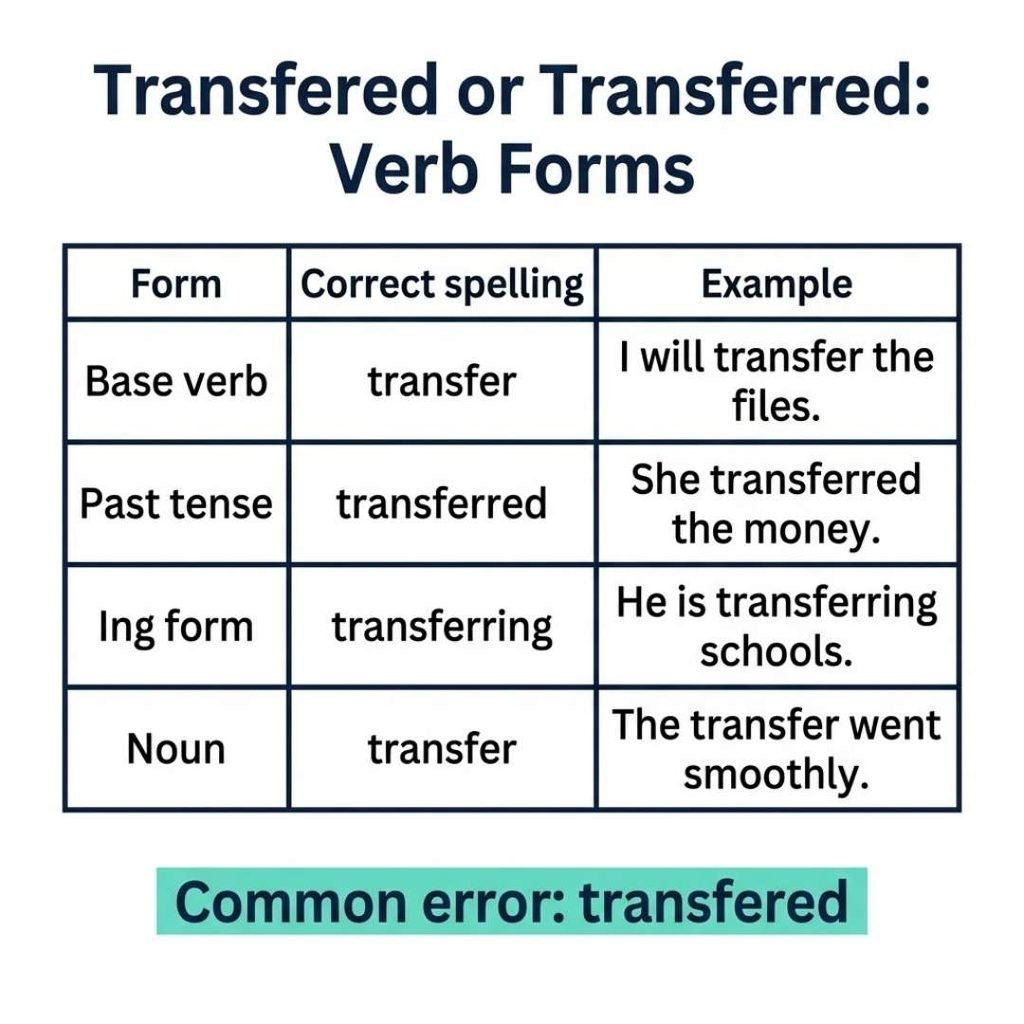
Transfered or Transferred in Every Verb Form
Each form of the verb follows the same logic. The base form has one R. Any ending that starts with a vowel and follows the stressed syllable doubles it.
Here is the full set. You write transfer for the base form and for I, you, we and they. You write transfers for he, she and it. You write transferred for the past and transferring for the continuous form.
Notice that transfers keeps one R. The ending s is not a vowel ending, so the rule does not apply. The same is true for the noun and its plural.
If you want a quick check, look at the ending. Ed and ing need two Rs. S and no ending need one. That small test solves most doubts.
Is There a Difference Between American and British English?
Some words split by region. Canceled and cancelled are a well known pair. Transferred is not one of those words.
In the sources checked for this article, transferred is the listed past tense form. Writers in the United States and the United Kingdom use it the same way. So you do not need to pick a regional version.
This makes the word easier than it looks. You can use transferred for any audience. Only the misspelling needs to be avoided.
Why People Write Transfered
The mistake is easy to understand. Many writers type the word as they hear it. In speech, the double R makes no sound, so the ear gives no warning.
Another reason is the noun. The noun transfer has one R, and writers may carry that spelling into the past tense. They add ed and forget to double the letter.
Speed also plays a part. People type fast in chat messages, emails and forms. A missing letter slips through when nobody reads the text twice.
Finally, a few similar words can confuse the pattern. Offered and suffered keep one R, so writers may guess that transferred does too. The stress rule explains why it does not.
Transferred in Sentences
These examples are illustrative. They show how the word works in common situations.
- The bank transferred the money on Friday.
- She transferred to a new school last year.
- Your call was transferred to another agent.
- We are transferring the files to a new laptop.
- He transferred ownership of the car to his sister.
Notice the pattern in each line. The verb is followed by an object or a place. The word to often shows the destination.
You can also use the word in passive sentences. For example, “The patient was transferred to another ward” puts the focus on the patient. Merriam-Webster gives a similar sentence about a patient moved to a different hospital.
Where You See Transferred in Daily Life
The word appears in many settings. Learning the common ones helps you spot the correct spelling at a glance.
Banking and payments
Banks and apps use the word for moving money between accounts. You might see a message that says your payment was transferred. In this setting, a typo can look careless and may reduce trust.
Schools and colleges
Students often transfer from one school to another. Merriam-Webster includes this sense, which describes leaving one educational institution to enroll at another. News about students and athletes uses the past tense often.
Work and careers
Employers transfer staff to new teams, offices or cities. A resume may say that you transferred to a new department. Spelling matters here, since hiring managers read your words closely.
Health care
A patient may be transferred from one ward or hospital to another. Medical notes and news reports use the word often. Merriam-Webster even uses this exact kind of sentence as an example.
Technology
People transfer files, photos and data between devices. Phone and email systems also transfer calls and messages. These uses are common in guides and support pages.
Travel
Travelers change from one train, bus or plane to another. That change is called a transfer. The noun keeps one R, but a traveler who changed vehicles transferred, with two.
Using the Right Preposition With Transferred
Writers often add a short word after the verb. The most common choice is to. It shows where something or someone moved.
You can also use from to show the starting point. For example, “He transferred from the London office to the Paris office” gives both. Use into when the destination is a system or a group.
None of these words changes the spelling of the verb. The form stays transferred in every case. Only the meaning of the sentence changes.
Transferable or Transferrable
A related question is the spelling of the adjective. It describes something that can be moved from one person or place to another. Both transferable and transferrable appear in dictionaries and in daily writing.
Merriam-Webster includes a definition of this adjective that means capable of being transferred or conveyed. Because usage varies, check your style guide. If you have no guide, pick one form and use it everywhere.
Some people say transferable skills when they describe abilities that work in many jobs. Others write transferrable skills. Both are readable, but consistency matters more than the choice.
Transfer as a Noun and as a Verb
Transfer works as both a noun and a verb, and the two uses sound slightly different. Merriam-Webster shows the verb with the stress on the second syllable. It shows the noun with the stress on the first syllable.
This shift explains why the spelling of the noun never doubles. You add nothing to it, so the stress rule has no work to do. The verb takes endings, so the rule applies.
The noun has several meanings too. It can mean the act of moving something, a ticket that lets you continue a trip on another route, or the passing of a right or title from one person to another. It can also describe how a learned skill carries over to a new situation.
Transferred Compared With Similar Words
Some words sound close to transferred, yet each has its own shade of meaning. Choosing the right one makes your writing clearer.
Moved is the plainest option and works almost anywhere. Relocated suggests a change of place, such as a new office or home. Sent focuses on delivery, while handed over focuses on giving control to someone else.
Transferred sits in the middle. It often suggests a formal or planned change, such as a new role, a new school or a new account. It also works well when something passes from one owner to another.
Switched is more casual and fits quick changes, such as switching seats. Use transferred when the move is official, recorded or part of a process.
Transferred in Formal and Informal Writing
The spelling rule stays the same in every style. Only the tone around the word changes. In an email, a note or a form, the correct spelling shows care.
Here are two illustrative lines. A formal message might say, “Your request was transferred to our billing team.” A casual text might say, “Just transferred the money, check your app.”
Both lines use the same spelling. A reader who spots transfered in either line may think the writer was careless. That small slip can weaken an otherwise clear message.
For work documents, proofread this word with extra care. Resumes, cover letters and reports often include it. A clean spelling supports a professional image.
Quick Practice: Pick the Correct Spelling
Try these short checks. The answers follow each line, and the lines are illustrative.
- She (transfered or transferred) to a new school. The answer is transferred.
- He is (transfering or transferring) the files now. The answer is transferring.
- The bank (transfers or transferrs) funds each day. The answer is transfers.
- I need a (transfer or transferr) to the red line. The answer is transfer.
If you answered all four correctly, you have the rule down. The ed and ing endings need two Rs. The s form and the noun need one.
Common Mistakes to Avoid
The most frequent mistake is writing transfered with one R. A second mistake is writing transferd, which drops the e as well. Both are wrong.
Another mistake is doubling the R in the noun. Writers sometimes type transferr or transferrs by habit. The noun and the s form keep one R.
Some writers also overcorrect. They double letters in words that do not need it, such as offerred. Remember that offered keeps one R because its stress falls on the first syllable.
Finally, do not rely only on a spell checker. Most tools flag the error, but a rushed edit can still miss it. A quick read before you send or publish is a better safeguard.
Easy Ways to Remember the Spelling
Try a simple memory line. Stress on the end means double and extend. If the last syllable carries the stress, double the consonant before the ending.
You can also practice with a group of look alike words. Say refer, prefer, defer, confer and transfer together. Then write the past tense of each one. All five double the R.
Another trick is to read the word in two parts. Say trans and ferred, and picture the double R as two small bridges. This image links the spelling to the idea of moving across.
If you write often, add the word to your style sheet. A short list of tricky words saves time on later projects. Over time, the correct spelling will feel natural.
FAQs About Transfered or Transferred
Is it transfered or transferred?
Transferred is correct. Transfered is a common misspelling that leaves out one R.
Why does transferred have two Rs?
The stress falls on the last syllable of the verb. When a verb ends that way, the final consonant doubles before ed or ing.
Is transferring spelled with two Rs?
Yes. Transferring has two Rs because the R doubles before ing. The noun transfer keeps only one.
Is transferred different in British English?
No. Transferred is the standard past tense form in American and British writing. Only the misspelling needs to be avoided.
Is transferable or transferrable correct?
Both forms appear in dictionaries and in daily writing. Pick one, check your style guide and stay consistent.
Conclusion
Transferred is the correct spelling, and transfered is a common error. The R doubles because the last syllable of the verb carries the stress. The same rule gives you transferring, referred and preferred.
Remember the quick test. Ed and ing need two Rs, while the noun transfer and the s form keep one. A short check before you publish will keep your writing clean.