Many writers pause when they type the past tense of “help”. The word looks short and simple, yet the ending can feel odd. You may have typed “helpped” and wondered if two p letters belong there.
This article answers one question: is it helpped or helped? You will learn the correct spelling, the rule behind it and how to use the word in real sentences. You will also find common mistakes, memory tips and a short practice set.
Helped Is the Correct Spelling
Helped is the correct spelling. It works as the simple past tense and the past participle of the verb “help”. The form “helpped” is a misspelling that does not appear in standard English.
You can write “She helped me move” or “He has helped many students”. In both sentences the word ends with a single p followed by ed.
Helpped or Helped Comparison Table
The table below shows each form at a glance. The example sentences are written for illustration only.
| Form | Is it correct? | Example | How to tell |
|---|---|---|---|
| helped (simple past) | Yes | She helped me yesterday. | The action is finished |
| helped (past participle) | Yes | They have helped before. | It follows has, have or had |
| helpped | No | Not used in standard English | It has an extra p |
| holp | Archaic or dialect | Found in older texts | You will rarely see it today |

What Does Helped Mean?
Helped is the past form of “help”. The verb means to give someone support or make a task easier. When you use “helped”, the support already happened.
According to Dictionary.com, the word is both the past tense form and the past participle of help. That means one spelling covers both jobs. You do not need to learn two different words.
Think of a simple pair. “I help my sister today” talks about now. “I helped my sister yesterday” talks about a finished action.
Why Helpped Is Wrong
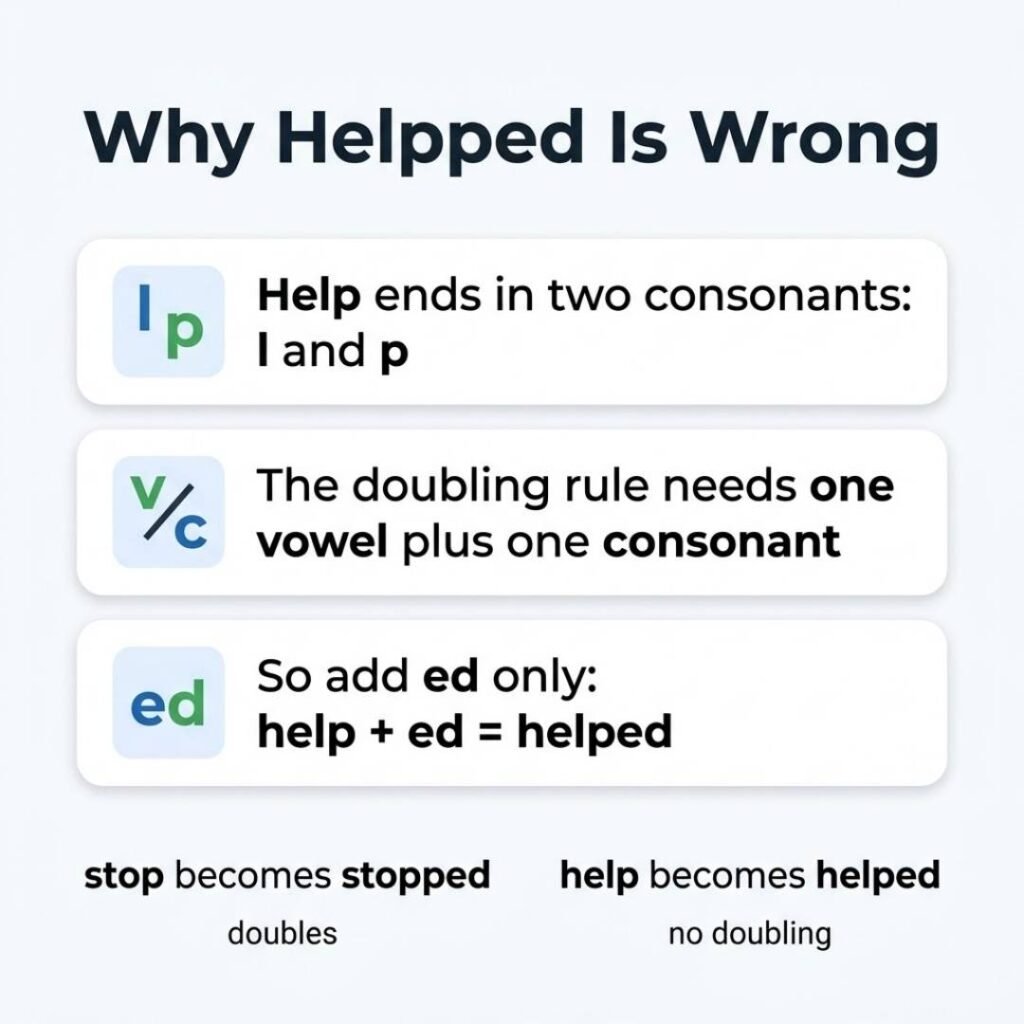
English has a common spelling rule that causes the mix up. Many short verbs double the last letter before ed. For example, “stop” becomes “stopped” and “plan” becomes “planned”.
That rule has a limit. It only applies when a verb ends in one vowel followed by one consonant. The verb “help” ends in two consonants, which are l and p. Because of that, you do not double anything. You simply add ed.
The sound of the word gives a clue too. Say “helped” aloud. You hear one p sound at the end, followed by a quick t sound. Nothing in the pronunciation points to a second p.
So the extra p in “helpped” has no job. It adds a letter without changing how the word sounds or what it means.
The Spelling Rule for Adding ED
Regular verbs form the past tense by adding ed. The rule has three small cases, and it helps to see all of them together.
First, most verbs just take ed. Examples include “walk” and “walked” or “jump” and “jumped”. Help belongs in this group.
Second, verbs that end in e only take d. “Love” becomes “loved” and “bake” becomes “baked”.
Third, short verbs with one vowel and one final consonant double that consonant. “Hug” becomes “hugged” and “drop” becomes “dropped”.
Help does not fit the second or third case. It ends in p, not e. It also has the consonant l before the p, so it does not match the one vowel and one consonant pattern. That leaves the first case. Add ed and stop.
Verbs Like Help That Never Double the P
Many verbs end in lp, mp or rp. They follow the same pattern as help. A few useful examples sit in the list below.
- yelp becomes yelped
- gulp becomes gulped
- jump becomes jumped
- camp becomes camped
- limp becomes limped
Notice that none of these verbs gain a second p. The consonant before the final p blocks the doubling rule.
Compare them with verbs such as “tap” and “clap”. Those end in one vowel and one consonant, so they become “tapped” and “clapped”. The difference is easy to see once you look at the letter before the p.
Helped, Help, Helps and Helping Compared
The verb has four common forms. Each has its own job, and mixing them causes many errors.
- help is the base form, as in “I help daily”
- helps is the third person present, as in “she helps daily”
- helping is the ing form, as in “they are helping now”
- helped is the past form, as in “he helped yesterday”
These forms match the Wiktionary entry for help, which lists helps, helping and helped for the verb. Notice that only one of them ends in ed. If the action is over, choose that one.
The word “helping” can also work as a noun. A helping is a serving of food, as in “a second helping of rice”. The spelling stays the same either way.
How to Use Helped as a Simple Past Verb
Use “helped” when the action is complete. The sentence often has a time word such as yesterday, last week or earlier. Here are a few examples.
- My brother helped me fix my bike.
- The teacher helped the class finish the project.
- We helped our neighbors carry the boxes.
The form never changes. It stays “helped” for I, you, he, she, we and they. You do not add an s for third person in the past tense. Say “she helped” and not “she helpeds”.
You can also use “helped” with another verb. Most of the time, the second verb stays in its base form. For example, “She helped me find my keys”. Some writers add the word “to”, as in “She helped me to find my keys”. Both versions are common.
How to Use Helped as a Past Participle
A past participle works with helper verbs. The most common helper verbs here are “has”, “have” and “had”. The spelling is the same as the simple past form.
Present perfect describes something that started in the past and still matters now. “She has helped many people find jobs.” Past perfect describes an action that happened before another past action. “I had helped him before the storm arrived.”
Future perfect uses “will have”. “By Friday, we will have helped every family on the list.”
All three tenses use the same word. This makes the spelling easy to remember. You only need one correct form for every perfect structure.
Be careful with the helper verb. Writers sometimes drop the ed and write “She has help me”. The correct version is “She has helped me”.
Helped in Passive Sentences
Passive sentences also use the past participle. They put the receiver of the action first. The pattern is a form of “be” followed by “helped”.
- The team was helped by a local volunteer.
- Many families were helped after the flood.
- The new student is being helped by a friend.
The spelling does not change here either. When you see “was”, “were” or “been” in front of the verb, use “helped”. Active sentences usually sound clearer. Passive ones work well when the person who helped is unknown or less important.
Common Phrases With Helped
Some phrases use “helped” in fixed ways. Knowing them can improve your writing and keep your spelling steady.
The phrase “helped out” means gave extra support. For example, “He helped out at the school fair.” The phrase “helped along” means made progress easier. “A good map helped us along the trail.”
You may also see “helped by”, which names the thing or person that gave support. “The company was helped by new software.” Another form is “helped with”, as in “She helped with the dishes”.
In all of these, the spelling is the same. The verb form remains correct in each case.
Helped in Everyday Writing
The word shows up in many settings. Seeing it in context makes the spelling feel natural. The sentences below are examples written for illustration.
In school work, you might write, “The experiment helped us understand heat.”And In an email, you could say, “Thanks for your note, it helped a lot.” In a review, you might write, “The guide helped me set up my account.”
News writers often use the word to show cause. A sentence such as “A strong dollar helped exports grow” follows that pattern. The Dictionary.com page for helped shows many real examples from major news outlets.
Whatever the setting, keep the spelling the same. Readers notice small errors, and “helpped” can make a polished message look rushed.
Helped and Helpful Are Different Words
Do not confuse “helped” with “helpful”. Helped is a verb form that shows a finished action. Helpful is an adjective that describes something useful.
For example, “She helped me” uses the verb. “She was helpful” uses the adjective. Helpful ends with a single l, so spellings such as “helpfull” are mistakes.
You can also add ly to get “helpfully”, which is an adverb. These related words all start from the base “help”. Each one has its own ending.
Why People Type Helpped
Nobody can say for sure why a writer types a wrong spelling. A few reasons seem possible. A fast typing slip can add an extra letter. Some writers also apply the doubling rule to every verb that ends in p.
Another possibility is that the writer copies the look of other words. Words such as “happy” and “slipped” have double p letters. A writer might repeat that pattern by habit.
Whatever the cause, the fix is easy. Remove the second p and the word is correct.
Is Holp a Real Past Tense of Help?
You may find the word “holp” in old books. Dictionary.com lists it as a nonstandard form from parts of the Southern United States. It also notes that British sources treat it as archaic.
The Wiktionary entry shows a similar picture. It lists “helped” as the standard past tense and “holp” as an archaic option. It also lists “holpen” as an old past participle.
So “holp” has a history, but it is not a modern choice. For school, work and everyday writing, use “helped”. Treat “holp” as a curiosity you might meet in older stories.
Common Mistakes With Helped
A few errors come up often. The first is the double p spelling. The second is using “help” when the sentence needs the past tense.
Look at this wrong sentence: “She help me yesterday.” The word “yesterday” signals the past, so the verb must be “helped”. The correct sentence is “She helped me yesterday.”
Another mistake is dropping the ed after a helper verb. Writers sometimes type “has help” when they mean “has helped”. Always add ed after has, have or had.
A third mistake is adding extra endings. Forms such as “helpeded” or “helpt” do not belong in standard writing. Use “helped” for the modern past tense.
A fourth mistake is switching tense inside one sentence. Compare “She helped me and then says goodbye” with “She helped me and then said goodbye”. Keep the tense steady unless the time truly changes.
Easy Ways to Remember the Spelling
Try these simple tips:
- Think of “help” as a word that already ends in two consonants.
- Remember that “yelped” and “gulped” also have one p.
- Read the word aloud and listen for one p sound.
- Run a spellchecker when you type fast.
You can also scan your draft for the letters “pp” after “hel”. If you find them, delete one p. A quick search in your document takes only a few seconds.
Another trick is to link the word with its base. Cover the ed ending and you see “help”. Then add ed back. Nothing else changes.
Quick Practice With Answers
Try filling in each blank with the right form. The answers follow the list.
- Yesterday, my cousin ___ me paint the room.
- She has ___ hundreds of students.
- The shop was ___ by a group of volunteers.
- Last week, we ___ at the food drive.
- Which spelling is correct: helpped or helped?
Answers: 1. helped. 2. helped. 3. helped. 4. helped. 5. helped.
Every answer uses the same form. That is the point of the lesson. One spelling covers simple past, perfect tenses and passive sentences.
FAQs About Helpped or Helped
Is it helpped or helped?
Helped is correct. Helpped is a misspelling. The verb help ends in two consonants, so you add ed without doubling the p.
What is the past tense of help?
The past tense of help is helped. The past participle is also helped. Both forms use the same spelling.
Is helpped ever acceptable?
No. Standard dictionaries do not list helpped. Use helped in school, work and everyday writing.
Why do some verbs double the last letter?
Short verbs that end in one vowel and one consonant often double it, as in stopped. Verbs ending in two consonants, such as help, do not.
Is holp the same as helped?
Holp is an old or dialect past tense of help. Modern writing uses helped.
Conclusion
The right spelling is “helped”. It works as both the simple past tense and the past participle of “help”. The extra p in “helpped” is a mistake, because the verb already ends in two consonants.
Keep the rule in mind and your writing will stay clean. Add ed to “help” and you are done.