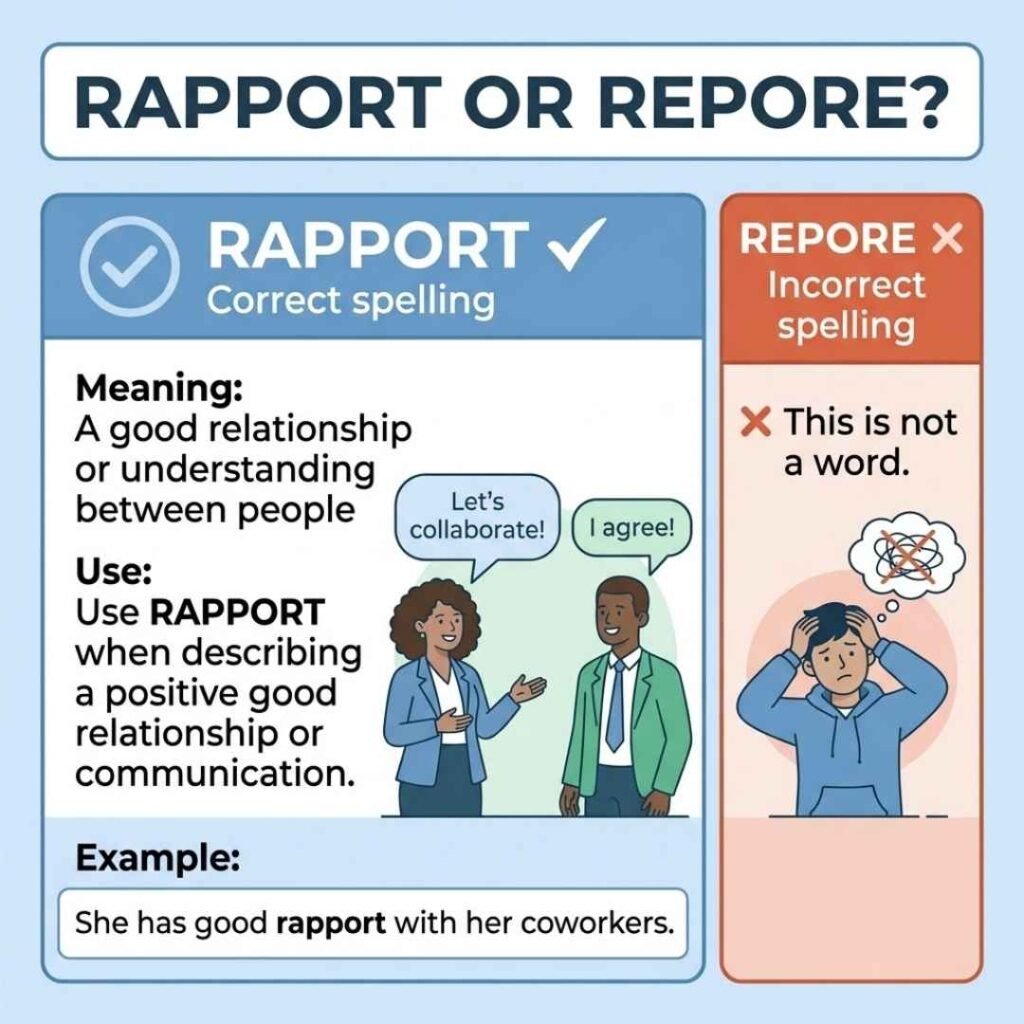
If you are unsure whether to write rapport or repore, the correct spelling depends on the word you mean. When you are talking about a good relationship, understanding or easy communication between people, the correct spelling is rapport.
This word can be confusing because its pronunciation does not make the spelling obvious. In this guide, you will learn what rapport means, how to pronounce it, why repore is incorrect and how to use rapport naturally in sentences.
Rapport or Repore?
Rapport is the correct spelling when you mean a friendly relationship or good understanding between people. Repore is not the standard English spelling of this word.
Cambridge Dictionary defines rapport as a good understanding of someone and an ability to communicate well with them. Oxford Learner’s Dictionaries describes it as a friendly relationship in which people understand each other very well.
Rapport vs Repore at a Glance
| Word | Correct? | Meaning | Example |
|---|---|---|---|
| Rapport | Yes | Good understanding or connection | We have good rapport. |
| Repore | No | Misspelling of rapport | Incorrect: good repore |
| Raport | No | Misspelling of rapport | Incorrect: build raport |
| Report | Yes, different word | An account of information | I wrote a report. |
What Does Rapport Mean?
Rapport is a noun that describes a good relationship between people. It suggests that people understand each other and can communicate comfortably.
For example:
The teacher has a good rapport with her students.
This means the teacher and students have a positive relationship and communicate well.
Rapport does not always mean friendship. A doctor can have good rapport with a patient. A manager can have good rapport with an employee. A salesperson can also develop rapport with a customer.
The main idea is mutual understanding and comfortable communication.
Cambridge gives examples such as developing a close rapport and having excellent rapport with staff. Oxford also shows that the word can be used with phrases such as “rapport with somebody” and “rapport between A and B.”
Why Is Rapport Spelled This Way?
The spelling rapport can look unusual to English learners because the word is pronounced differently from how many people expect it to sound.
Oxford lists the word as coming from French and traces it to the French verb rapporter.
English has many words borrowed from other languages that keep spelling patterns that are not immediately obvious from their pronunciation. Rapport is one of them.
The easiest thing to remember is the spelling itself:
R A P P O R T
Notice the two Ps in the middle and the final T.
How Do You Pronounce Rapport?
Cambridge gives the English pronunciation as approximately rap POR, with the stress on the second syllable. Its listed UK pronunciation is /ræpˈɔːr/ and its US pronunciation is /ræpˈɔːr/.
The pronunciation can make the spelling confusing because the final t is not pronounced as a clear “t” sound in English.
This explains why someone who has mainly heard the word in conversation might guess a spelling such as repore.
However, pronunciation should not be used as the spelling guide here. When you mean a good relationship, write rapport.
Is Repore a Word?
Repore is not the standard English spelling of rapport.
If you write:
She has a good repore with her clients.
the standard correction is:
She has a good rapport with her clients.
The mistake is understandable because repore looks like a possible spelling based on the sound of the word. However, standard English uses rapport for this meaning.
The same rule applies whether you are writing casually or formally. In an email, essay, report or professional document, use rapport.
Is Raport Correct?
Raport is also not the standard English spelling when you mean a good relationship.
The correct sentence is:
He quickly built rapport with the team.
Not:
He quickly built raport with the team.
The main spelling problem is the missing second p. Remembering RAPP at the beginning can help you avoid this error.
Easy spelling tip
Think:
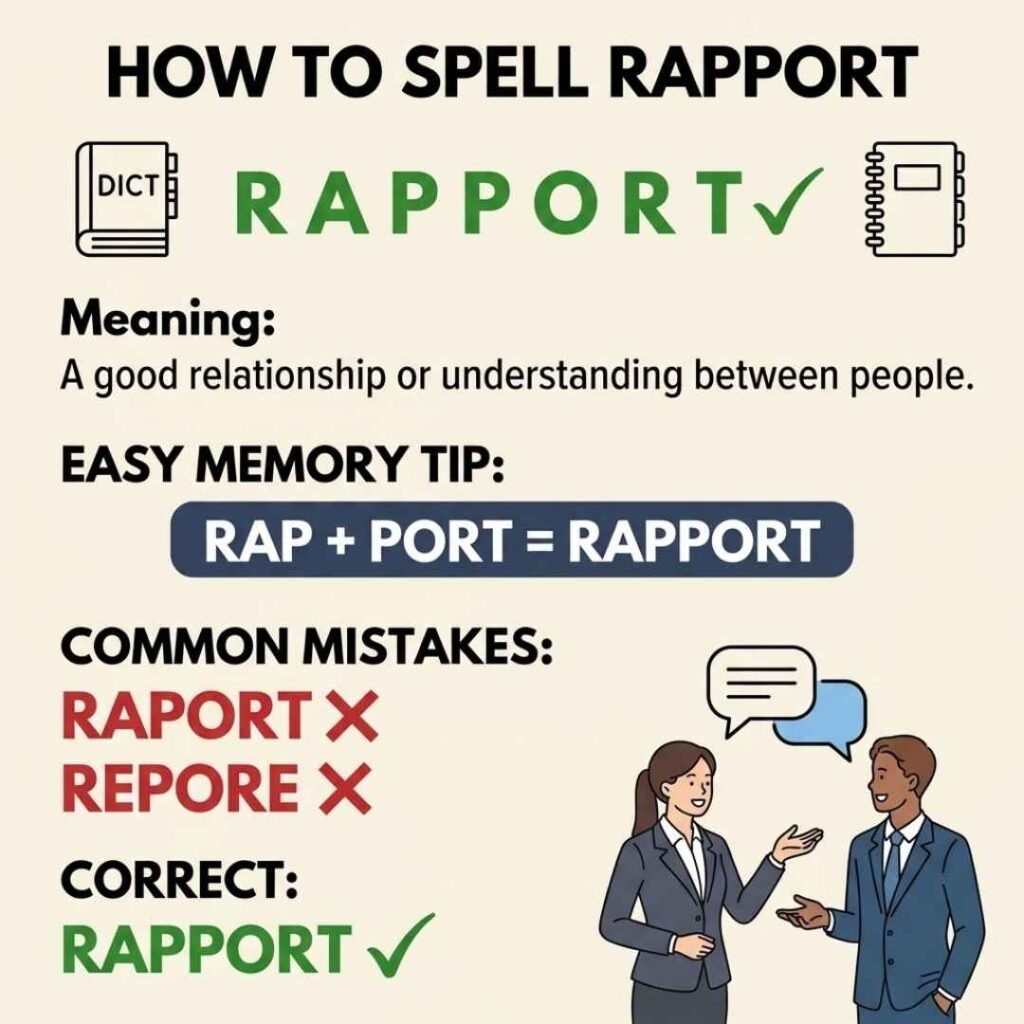
RAP + PORT = RAPPORT
That gives you the two Ps and the correct ending.
Rapport vs Report
Do not confuse rapport with report. Both are real English words, but they have different meanings.
A report can be a written or spoken account of information, events or findings.
For example:
The manager prepared a report about the project.
A rapport is a good relationship or understanding between people.
For example:
The manager has excellent rapport with the team.
The two words may look somewhat similar, but they belong in different contexts.
How to Use Rapport in a Sentence
Rapport commonly appears with verbs such as build, develop, establish and create.
Here are some simple examples:
The teacher built good rapport with the class.
The doctor developed rapport with her patient.
We quickly established rapport during the meeting.
She has excellent rapport with her coworkers.
Good communication can help create rapport.
The coach has a strong rapport with the players.
These sentences all describe a positive connection between people.
Common Phrases With Rapport
Knowing common word combinations can make the spelling easier to remember.
Build Rapport
Build rapport means to develop a positive relationship.
The interviewer tried to build rapport with the candidate.
Establish Rapport
Establish rapport means to create a comfortable connection.
The therapist worked to establish rapport with the client.
Develop Rapport
Develop rapport means to gradually form a good relationship.
She developed rapport with the new team.
Good Rapport
Good rapport describes a positive relationship.
They have good rapport with each other.
Strong Rapport
Strong rapport suggests a particularly positive connection or understanding.
The teacher has strong rapport with her students.
Rapport With Someone or Rapport Between People?
Both structures are correct.
Use rapport with when you focus on a person’s relationship with another person or group.
She has excellent rapport with her customers.
Use rapport between when you focus on the relationship between two people or groups.
There is strong rapport between the two colleagues.
Oxford specifically lists both rapport with somebody and rapport between A and B among its usage patterns.
Rapport Examples in Everyday English
The word can appear in many different settings.
At Work
The manager has a good rapport with the staff.
This means the manager communicates well with the staff and has a positive relationship with them.
In Education
The teacher quickly developed rapport with the students.
Here, rapport refers to a comfortable and understanding relationship between the teacher and students.
In Healthcare
The doctor established good rapport with the patient.
This suggests that the doctor and patient communicate comfortably and understand each other well.
In Customer Service
The representative built rapport with the customer.
The representative developed a positive connection during the conversation.
In an Interview
The interviewer created rapport with the candidate.
The sentence suggests that the conversation became comfortable and communicative.
In Personal Relationships
We had an instant rapport when we met.
This means the two people connected easily and felt comfortable communicating.
Is Rapport the Same as Friendship?
No. Rapport and friendship can overlap, but they are not the same thing.
Friendship usually describes a personal relationship that can involve affection, trust and shared experiences. Rapport focuses more on understanding and communication.
For example, a doctor and patient may have excellent rapport without being friends.
Likewise, a teacher and student can have strong rapport while keeping a professional relationship.
So, a simple way to remember the difference is:
Friendship is a type of relationship. Rapport describes how well people understand and communicate with each other.
Is Rapport the Same as a Relationship?
Not exactly.
Relationship is a broad term for a connection between people or groups. Rapport is more specific and focuses on mutual understanding, harmony and communication.
Compare these examples:
They have a professional relationship.
This tells you what type of relationship they have.
They have good rapport.
This tells you that they communicate well and understand each other.
Someone can have a relationship with another person without having good rapport. The word rapport therefore adds a specific idea about the quality of communication.
Is Rapport Formal or Casual?
Rapport can be used in both everyday and professional English.
You might say:
We have great rapport.
You could also write:
The consultant established a strong rapport with the client.
The word is especially common when people discuss communication, teamwork, education, interviews, healthcare and professional relationships.
It is not limited to formal writing. However, simpler words such as connection, understanding or relationship may sound more natural in some casual conversations.
Common Misspellings of Rapport
The unusual pronunciation can lead to several spelling mistakes.
| Incorrect form | Correct form | Example |
|---|---|---|
| repore | rapport | good rapport |
| raport | rapport | build rapport |
| repor | rapport | develop rapport |
| rapore | rapport | strong rapport |
| rappore | rapport | establish rapport |
If you are writing about a good relationship, rapport is the standard form to use.
How Can You Remember the Correct Spelling?
A simple memory trick is:
RAP + PORT = RAPPORT
You can also remember three key points:
Two Ps: RAPP
Ends in T: RAPPORT
Meaning: Good understanding between people
Try using the word in a sentence:
I have good rapport with my coworkers.
Writing the word several times in meaningful sentences can make the unusual spelling easier to remember.
Why Do People Write Repore Instead of Rapport?
The most likely reason is pronunciation. Cambridge’s pronunciation guide shows that rapport is pronounced approximately /ræpˈɔːr/ in both its UK and US entries.
When people hear a word without seeing it written, they may try to spell it according to its sound. That can produce forms such as repore or raport.
The spelling becomes easier once you connect the sound with the written form:
Rapport = rap POR
The important point is that repore is not an alternative spelling of the English noun rapport.
Does British or American English Use a Different Spelling?
No. The standard spelling is rapport in both British and American English.
Cambridge lists UK and US pronunciations for the word, while Oxford also uses the spelling rapport.
The pronunciation can vary slightly between speakers, but you do not need a different spelling for British and American English.
What Is the Opposite of Rapport?
There is no single perfect opposite in every situation.
Depending on the context, you might describe the opposite as:
poor communication
lack of understanding
tension
disconnection
For example:
There was little rapport between the two teams.
This indicates that the people did not have much mutual understanding or comfortable communication.
Oxford provides the example of there being “little rapport” between two people, showing that rapport can exist at different levels rather than simply being present or absent.
Frequently Asked Questions
Is it rapport or repore?
It is rapport when you mean a good relationship or understanding between people.
Is repore a correct spelling?
No. Repore is not the standard spelling of the English word rapport.
What does rapport mean?
Rapport means a good understanding and comfortable communication between people.
How do you spell rapport?
The correct spelling is rapport, with two Ps and a final T.
Is rapport the same as friendship?
No. Rapport means good understanding and communication. People can have rapport without being friends.
Conclusion
If you are choosing between rapport or repore, use rapport when you mean a good relationship or understanding between people. Repore is not the standard English spelling.
Remember the spelling with this simple pattern: RAP + PORT = RAPPORT. Once you connect the pronunciation with the correct written form, this commonly confused word becomes much easier to use.