MYF meaning in text is not as simple as it looks. You may see it in a comment, a direct message or a caption and wonder if it is a typo. This article explains what people most likely mean when they send it.
Online guides do not agree on one definition, so this article compares the meanings and shows how to tell them apart. You will also find example messages, sample conversations, reply ideas and common mistakes to avoid.
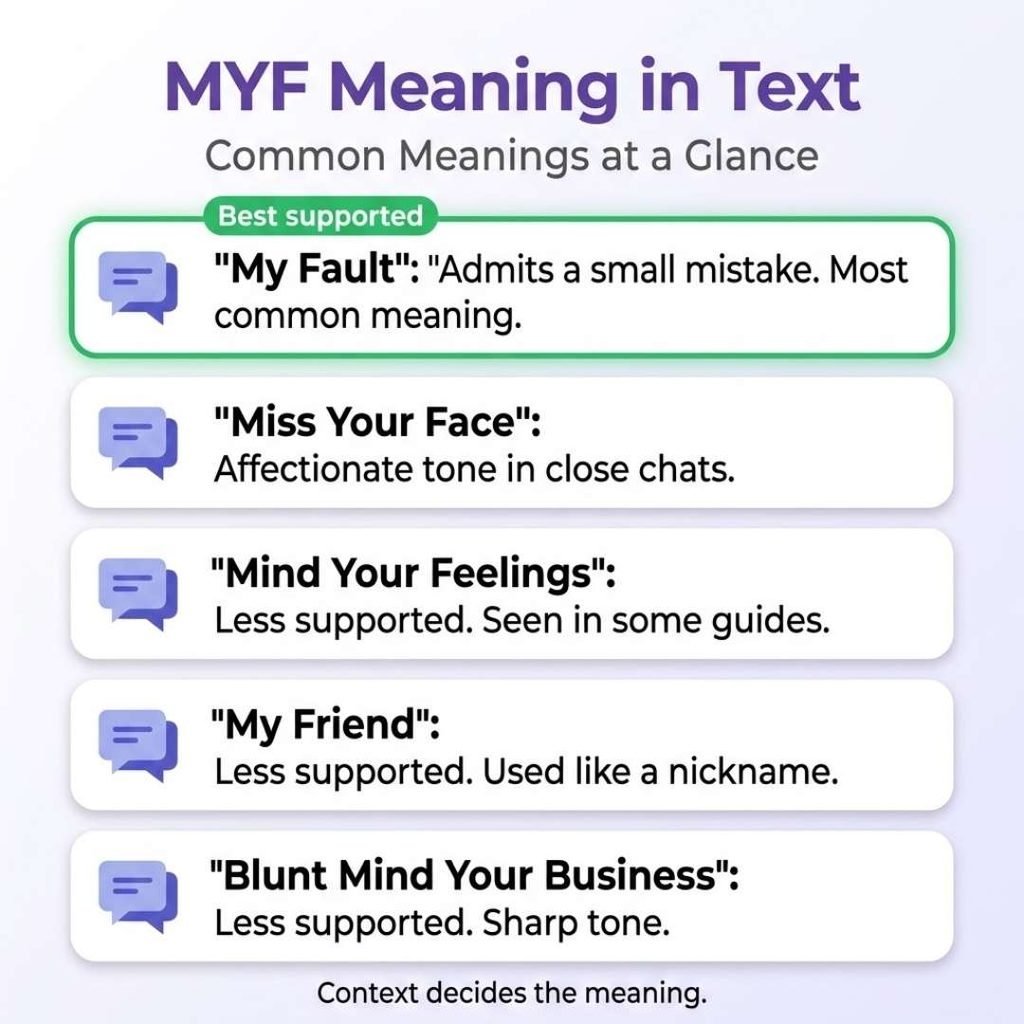
In most cases, MYF is short for “my fault.” People use it to admit a small mistake in a casual way. In warm, personal messages it may instead mean “miss your face.” No official dictionary sets one meaning, so the message around it decides.
Common Meanings of MYF at a Glance
| Context | Possible meaning | Example (illustrative) | How to tell |
|---|---|---|---|
| Admitting a mistake | My fault | “Sent the wrong link, myf” | A slip or delay came just before |
| Warm or close chat | Miss your face | “Saw a photo of us, myf” | Affectionate tone, no mistake |
| Emotional talk | Mind your feelings (less supported) | “Calm down, myf” | Chat is about reactions |
| Friendly greeting | My friend (less supported) | “Thanks, myf” | Used like a nickname |
| Pushing back | Blunt “mind your business” (less supported) | “Not your call, myf” | Sharp tone after a question |
Why Guides Disagree About MYF
Search results for this term show a wide split. Different guides list “my fault,” “miss your face,” “mind your feelings,” “my friend” and a blunt mind-your-business phrase. Most present their favorite meaning with confidence. Few explain where the claim comes from.
The most useful outside support is thin but consistent on one point. Dexerto explains that on TikTok, MYF is usually short for “my fault,” and people use it to acknowledge a mistake or take responsibility. It adds that the term can also stand for other things such as “miss your face.” Dexerto
The Wikipedia page for Myf also lists “my fault” as the internet slang meaning. That page is a general disambiguation entry, not a slang dictionary, so treat it as light support only.
This article does not give an origin or a date for the term. No reliable source found for this article shows where MYF began. Guides that state a clear origin offer no proof for it.
MYF Meaning in Text: The Best Supported Answer
The best supported meaning is “my fault.” It has the most consistent backing across sources. It is also the meaning that fits the most common situation, which is a quick apology in a casual chat.
MYF as “My Fault”
People use it the way they use “my bad.” It admits a small slip without making a big deal of it. The tone is light and the goal is to keep the conversation moving.
Here are two example messages. Both are made up to show the pattern.
- “Sorry I missed your call, myf.”
- “Wait, I sent that to the wrong chat. myf 😭”
You will often see it in comments, captions, group chats and direct messages. It fits small errors such as a late reply, a wrong link or a forgotten plan. It does not suit a serious apology. If you hurt someone, a full sentence shows more care.
The clue is timing. If a mistake, delay or misunderstanding came just before the message, “my fault” is the likely meaning. A short reply like “no worries” then closes the moment.
MYF as “Miss Your Face”
This meaning is real but less certain. It appears in more affectionate chats where someone wants to say they miss another person. It sounds softer than “I miss you” and can feel playful.
An example message shows how it might look: “Just saw a photo from last summer, myf.” Nothing in it admits a mistake. The message shows a warm feeling.
Some guides say this version shows up in close friendships or romantic chats. That claim comes from general guides, not a dictionary, so treat it as a pattern rather than a rule. Look for affectionate emojis, a friendly tone and a message that arrives out of the blue. Those clues point toward “miss your face” instead of “my fault.”
Other Possible Meanings
A few guides list other meanings. They are possibilities, not established facts.
“Mind your feelings” appears in some guides as a reminder to stay calm or stay aware of emotions. “My friend” appears in others as a casual nickname. One guide lists a blunt phrase that tells someone to mind their own business. It says people often add emojis to soften that tone.
None of these has strong outside support. If you see one of them in a real chat, the surrounding words should make it clear. When they do not, ask the sender.
MYF Outside Texting
Not every MYF is slang. The Wikipedia page also shows Myf as a nickname for people named Myfanwy and lists MYF as the airport code for Montgomery Field in San Diego. It also lists a protein called MYF5.
So a capitalized “Myf” in a message may be a person’s name. A friend might write “Myf is coming tonight” without any slang at all. Check whether the word stands in for a person before you decode it.
Where You May See MYF
The term is not tied to one app. Dexerto notes that it is not exclusive to TikTok and appears on platforms such as Twitter/X, Snapchat and Instagram. You may also meet it in plain text messages and group chats. Dexerto
This article does not claim that the meaning changes by app, age group or region. No source reviewed for this article backs up such a claim. The safer approach is to judge each message by its own clues.
Comments and captions are public, so a “my fault” reading is common there when someone owns a small error. Direct messages are private, so affectionate readings become more believable between people who know each other. Treat this as a rule of thumb, not a proven pattern.
How to Tell Which Meaning Someone Intends
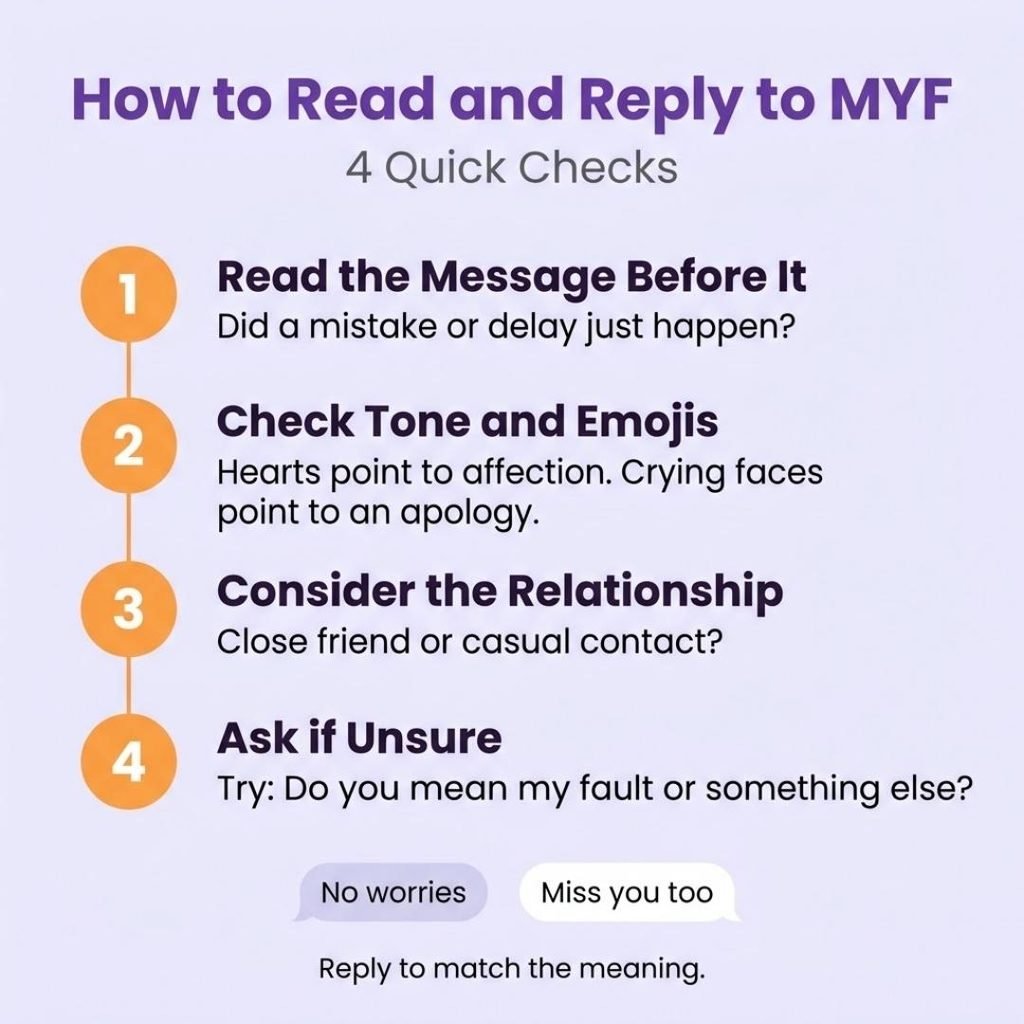
Context beats the letters every time. Use a few quick checks before you reply.
Read the Message Before It
Look at what came just before the MYF. If a mistake, delay or wrong message happened, “my fault” is the strongest guess. If the chat was calm and warm, another meaning becomes more likely.
Check the Tone and Emojis
Emojis change how a short abbreviation feels. A crying face often goes with an embarrassed apology. A heart or a smile can point toward affection. A smirk may signal a playful or blunt tone.
Consider Your Relationship
The same letters can carry a different weight from a close friend than from a coworker. An affectionate meaning is more plausible from someone you know well. A casual apology is plausible from almost anyone.
Know When to Ask
If the clues do not agree, ask. A short question such as “Wait, what does myf mean here?” costs nothing. Guessing wrong can lead to an awkward reply, especially if you read a romantic meaning into a simple apology.
Example Conversations
These short chats are made up. They show how context changes the meaning.
An Apology
- A: “Did you see my text about dinner?”
- B: “No, my phone died. myf, I should have told you.”
- A: “All good, see you at 7.”
The mistake comes first, so “my fault” fits. The reply is calm and closes the topic.
A Warm Message
- A: “Just got home. Long day.”
- B: “Rest up. myf 🥺”
- A: “Aw, miss you too.”
No error appears anywhere in the chat. The emoji and the caring tone point toward “miss your face.” The reply confirms that reading.
An Unclear Message
- A: “myf”
- B: “Do you mean my fault, or something else?”
- A: “Oh, my fault. I forgot the file.”
The single word gave no clues. A quick question solved it in one turn. This is often the fastest path when the context is thin.
How to Reply When Someone Sends MYF
Match your reply to the meaning you think the sender intends. Keep it short and natural.
If it means “my fault,” a friendly reply works. You might write “No worries” or “All good.” If the mistake caused a real problem, say so calmly and explain what you need.
If it means “miss your face,” your reply depends on how you feel. Between close friends, “Miss you too” is warm and simple. If you are unsure of the tone, a light reply such as “Aw, thanks” keeps things friendly without promising more.
If the meaning is unclear, ask a direct question. You can write “Do you mean my fault or something else?” That gives the sender an easy way to explain. It also avoids a reply that does not fit.
If the message feels blunt or sharp, stay calm. Read the earlier messages again. The sender may be joking, or you may have crossed a line. A short, respectful response usually helps.
Common Misunderstandings About MYF
The biggest mistake is treating MYF as a fixed abbreviation. Unlike LOL, it has no single agreed meaning. Reading it as one thing every time leads to wrong guesses.
Another mistake is trusting the first guide you find. Many guides state one meaning as fact without a source. As shown above, they contradict one another. Look for support beyond a single blog before you decide.
A third mistake is assuming a romantic meaning. “Miss your face” can be friendly. It does not always signal interest. Read the relationship and the tone first.
Finally, do not assume MYF is always slang. It can be a typo, a name or a code in a non-text setting. A message that makes no sense as slang may simply contain a mistake.
How to Read Slang You Do Not Know
MYF is one example of a wider problem. Short abbreviations lose the tone of speech, so readers fill the gap with guesses. A few habits help with any unfamiliar term.
Start with the words around it. Most slang gets its meaning from the sentence it sits in. A term that follows a slip usually relates to that slip.
Next, check more than one source. If two or three sources give different answers, as with MYF, the term probably has no fixed meaning. Say so to yourself and lean on the chat instead.
Then think about the sender. A close friend, a classmate and a stranger use slang in different ways. Their past messages often show how they write.
Last, ask when it matters. A quick question is better than a wrong reply in an important conversation. Most people are glad to explain their own shorthand.
MYF Compared With Similar Abbreviations
Some abbreviations look alike or do a similar job. Knowing them helps you avoid mix-ups.
“My bad” is the closest match to the main meaning. It also admits a small mistake in a relaxed way. Many people know it well, which makes it a safer choice when you want to be clear.
“IMY” stands for “I miss you.” It states the feeling more directly than “miss your face.” MYOB stands for “mind your own business.” It shares a few letters with MYF but has a different pattern and a firmer tone.
Because these abbreviations overlap in letters, the context matters even more. When two readings seem possible, ask instead of guessing.
Should You Use MYF in Your Own Messages?
You can use it with friends when the meaning will be obvious. A quick “myf” after a small slip is easy to read in a casual chat. Adding a few extra words makes it even clearer.
Avoid it in work messages, school emails or any serious apology. It can look careless there. It can also confuse readers who have never seen it.
If your reader may not know the term, spell the phrase out. Writing “my fault” or “miss your face” removes the doubt. That small change can save you a confusing follow-up.
FAQs
What does MYF mean in text?
Most often it means “my fault.” In affectionate chats it may mean “miss your face.” The message around it decides.
Is MYF the same as my bad?
Roughly, yes. Both admit a small mistake in a casual way. “My bad” is the more familiar phrase.
Does MYF mean miss your face?
Sometimes. Some sources list it as an affectionate meaning, but it is less certain than “my fault.”
Is MYF a real word?
No. It is informal internet shorthand, not a standard word. Its meaning depends on the conversation.
How do I reply to MYF?
Match the meaning. Say “no worries” to an apology or “miss you too” to an affectionate message. If unsure, ask.
Conclusion
MYF meaning in text most likely points to “my fault,” with “miss your face” as a common alternative. Other meanings exist in some guides but lack strong support. No single official definition settles the question.
The surrounding message is your best clue. Read the earlier lines, the tone and the relationship. If you still cannot tell, ask the sender.
Pingback: BBJ Meaning in Text: What Does BBJ Really Mean? - Centowise