Many people type “gitty” when they mean “giddy”. The two words look alike and sound close, so the mix-up is easy to make. This article explains which spelling is standard and when each word is correct.
You will also see example sentences, a comparison table and tips for choosing the right word. By the end, you will know how to spell the word you need and how to read it when someone else writes it.
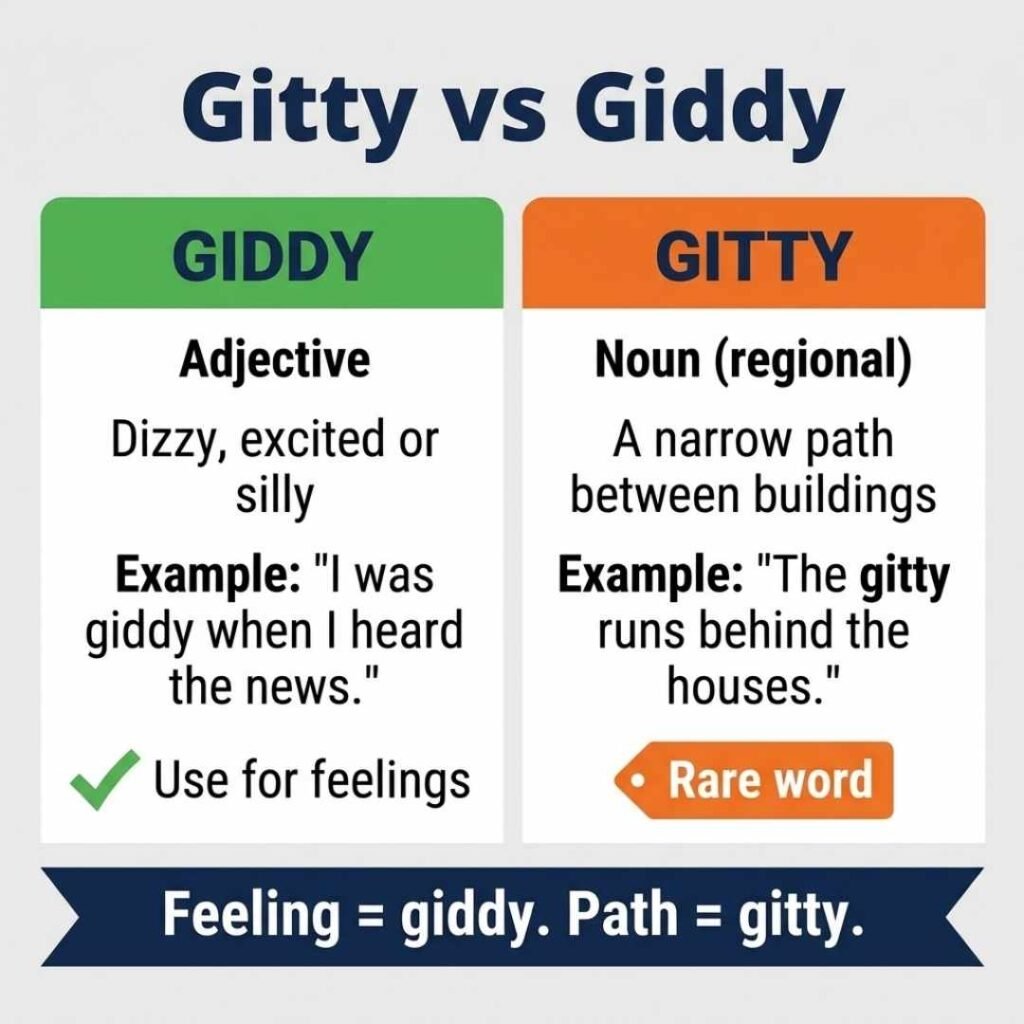
Giddy is the standard spelling for feeling dizzy, very excited or a little silly. Gitty is not a spelling variant of giddy. It is a separate, rare word. In dictionaries it is a regional noun for a narrow passage between buildings or fences.
If you want to describe a dizzy or thrilled feeling, write giddy.
Gitty or Giddy at a Glance
The table below shows where each spelling fits. The example sentences are illustrations written for this article.
| Context | Likely word | Example | How to tell |
|---|---|---|---|
| Feeling dizzy | Giddy | “I felt giddy at the top of the tower.” | Describes a body feeling |
| Feeling very excited | Giddy | “She was giddy about the trip.” | Describes a happy mood |
| Acting silly or frivolous | Giddy | “He gave a giddy laugh.” | Describes light behavior |
| Midlands alley or path | Gitty (noun) | “We cut through the gitty to school.” | Names a place, not a feeling |
| Scots baby talk | Gitty (noun) | Appears in an old rhyme | Rare and historical |
| Unsure typo | Giddy | “I’m so gitty today.” | Describes a feeling, so use giddy |
Notice that the first three rows all describe a person or a mood. Only the gitty rows name a thing or place. That one difference solves most cases.

What Giddy Means
Giddy is an adjective. It has a few related meanings, and the context tells you which one the writer has in mind. According to Vocabulary.com, the word can describe dizziness, joyful excitement or a lack of seriousness. Some meanings overlap, which is why the word can feel hard to pin down.
Giddy as Dizzy
The physical meaning is the one many people learn first. You feel giddy when the room seems to spin. Heights, fast spinning or standing up too quickly can all bring it on. In this sense the word is close to dizzy, woozy or lightheaded.
Example: “The steep stairs made me feel giddy.”
Writers may also use giddiness for this feeling. If dizziness is strong or keeps returning, a medical professional is the right person to ask, not a dictionary.
Giddy as Excited
Today many people use giddy for a bright, happy kind of excitement. The feeling is light and bubbly. You may feel giddy before a party or after good news. People often say they are giddy with excitement or giddy with joy.
Example: “The kids were giddy with excitement on the last day of school.”
This sense often carries a playful tone. A person who is giddy may laugh more, talk faster or struggle to sit still. The word suggests a joy that is a little hard to control.
Giddy as Frivolous
Giddy can also mean not serious or given to silliness. This sense is less common in daily talk. It can sound a little old-fashioned. Vocabulary.com notes that people have used the word this way since the 16th century.
Example: “Her giddy mood made the meeting hard to focus on.”
A writer might choose this sense to describe a careless or scatterbrained person. It can sound critical, so use it with care when you describe a real person.
How to Tell Which Meaning Is Intended
Nearby words give strong clues. Talk of heights, spinning or standing up points to dizziness. And Talk of news, trips or love points to excitement. Talk of jokes, moods or careless behavior points to silliness.
When the clues are mixed, the sentence may play on two meanings at once. A person on a roller coaster might feel giddy in both ways. Writers sometimes use that overlap on purpose. In that case, either reading can be right.
Giddy in Common Phrases
Some phrases use giddy again and again. Learning them helps you spot the right spelling quickly.
Giddy with excitement is one of the most common. It means extremely happy and thrilled. Giddy with delight and giddy with joy work the same way.
Giddy heights refers to a very high place or rank. A writer might describe someone who reached the giddy heights of a career. The phrase blends the dizzy feeling of height with the idea of great success.
A giddy spell is a short episode of dizziness. You may hear it in older writing or in a health setting.
Giddy in love describes someone who is happily and a little foolishly in love. Vocabulary.com also points to the old phrase giddy as a schoolgirl, which it calls a cliche. That phrase can sound dismissive, so a fresher image is often a better choice.
Where Does the Word Giddy Come From?
The history of giddy is a little surprising. Vocabulary.com says the Old English source word, gidig, meant insane or possessed by a god. Over time the word moved toward the lighter meanings we use today.
This origin note comes from one dictionary source. Exact dates and paths of change can differ between references, so treat the story as a general outline.
Is Gitty a Real Word?
Yes, but it is a different word with a different job. The sources checked for this article do not list gitty as a normal way to spell giddy. Its known uses are narrow and mostly regional.
Gitty as a Passageway
Wiktionary records jitty as an alternative spelling of gitty. Both name a narrow path between buildings, fences or hedges. The entry marks the term as colloquial and tied to the English Midlands. It also says the word is used in some mining communities in the south east.
The same entry traces the word to Low German twiete, which means alley. It also notes a historic Sussex form, twitten.
Example: “The gitty runs behind the row of houses.”
Because this is a regional word, many readers outside the Midlands may not know it. If you use it, a short clue in the sentence can help.
Gitty in Old Scots
The Dictionary of the Scots Language lists gitty as a nonsense word used with a baby. Its example comes from an 1847 collection of rhymes. This use is historical, so you are unlikely to meet it in everyday writing.
Gitty Is Not a Spelling Variant of Giddy
No source reviewed for this article presents gitty as an accepted spelling of giddy. If you write “I feel gitty”, most readers will see a typo. Some may not understand you at all.
One word lookup site flags gitty as a possible misspelling and suggests similar words instead.
Why People Mix Up Gitty and Giddy
The two words share a similar shape and rhythm. In American English a t between two vowels often sounds close to a d. That can make gitty and giddy seem alike when spoken aloud. Autocorrect and fast typing add to the confusion. Reading fast makes the slip more likely because the brain fills in the word it expects.
The mix-up may also come from other words that end in tty, such as chatty or witty. Those words describe a quality or mood. A writer may assume gitty follows the same pattern. It does not.
Another cause is the sound of the first syllable. Both words start with a hard g and a short i, so only the middle consonant tells them apart.
How to Choose the Right Spelling
Use a simple test. Ask what the word describes.
If it describes how someone feels, write giddy. That includes dizzy, thrilled or lightheaded feelings. If it names a narrow path between buildings, gitty may fit, but only if your readers use that regional word.
Try these quick checks before you publish:
- Does the word describe a feeling? Use giddy.
- Does it name a path between walls? Gitty or jitty may fit.
- Is the audience outside the Midlands? Consider the word alley or passage.
Here are more examples to test your ear:
- “I was giddy when I heard the news.” This is correct.
- “The heights made her giddy.” This is correct.
- “I was gitty when I heard the news.” This is a typo.
- “A giddy laugh carried down the hall.” This is correct.
Spelling Tips to Remember
A few memory tricks make the spelling stick. Giddy and dizzy both have a double letter in the middle. That small match can help you link the word to the feeling.
Another trick pairs each word with its job. Gitty and jitty belong to the path. Giddy belongs to the person or mood.
You can also read your sentence aloud and swap in excited or dizzy. If either fits, giddy is the right spelling.
Related Forms of Giddy
Giddy changes form in ways that are easy to remember. Giddier and giddiest compare degrees. Giddiness is the noun for the feeling. Giddily is the adverb. Giddying appears in dictionaries as a verb form.
Example: “Her giddiness faded after she sat down.”
Example: “They laughed giddily all the way home.”
Giddy Compared With Similar Words
Giddy vs Dizzy
Dizzy and giddy overlap for the physical feeling. Both can describe a spinning sensation. Giddy often adds a note of lightness or joy, while dizzy tends to stay with the body. One language learning site says giddy feels a bit more old-fashioned and romantic when it describes happiness.
Giddy vs Excited
Excited is a plain, general word. Giddy adds a hint of silliness or lost control. Someone who is excited may stay calm on the outside. Someone who is giddy usually shows it.
Giddy vs Silly
Silly describes behavior that lacks sense or seriousness. Giddy can overlap with it, but giddy points more to a mood than a habit. A giddy person is caught up in a feeling. A silly person may simply enjoy jokes.
Useful synonyms depend on the meaning:
- Dizzy: woozy, lightheaded, unsteady
- Excited: thrilled, elated, overjoyed
- Frivolous: silly, airheaded, featherbrained
Pick the one that fits your tone and your reader.
Using Giddy in Messages and Social Posts
People use giddy in texts and posts to show a happy, wobbly kind of excitement. The spelling stays the same in casual writing. Typing giddy keeps your message clear.
These example messages are illustrations, not quotes from real chats:
- “Got the job! I’m so giddy right now.”
- “Just stood up too fast and felt giddy for a second.”
- “We are giddy about the trip. Ten days to go.”
Notice that each message shows a feeling or a physical sensation. None names a place. If a friend sends gitty in a message like these, a typo is a reasonable first guess. Their next message or the topic usually confirms it.
Style Tips for Using Giddy
Giddy works well in warm, personal writing. It suits blog posts, stories and friendly emails. In formal reports a plainer word such as excited or pleased may fit better.
Avoid repeating the word again and again in one piece. One strong use does more than five weak ones. Pair it with a detail instead, such as a laugh or a fast heartbeat, so the reader can picture the feeling.
Take care when you apply the word to real people. Giddy can sound warm or it can sound dismissive. Think about how the person would feel reading it.
Common Mistakes to Avoid
Writers often make the same few slips. Watch for these when you edit.
First, do not use gitty to describe a mood. Second, do not assume a casual tone makes gitty correct. Third, do not treat the regional noun as a version of giddy. Each one changes the meaning or confuses the reader.
Another slip is using giddy for a path or place. Giddy never names an alley or a walkway. Autocorrect can also swap one word for the other, so give your text a final read. A quick proofread catches most of these errors.
Some writers stretch the word in casual chat, as in giddyyy, to show extra feeling. That style is fine for friends but not for articles or formal notes.
FAQs
Is gitty a correct spelling of giddy?
No. Giddy is the standard spelling for dizzy or excited feelings. Gitty is a separate, rare word for a narrow passage.
What does gitty mean?
In the Midlands, gitty can mean a narrow walkway between walls, fences or hedges. In older Scots, it was a nonsense word used with babies.
What does giddy mean?
Giddy usually means dizzy, very excited or a bit silly. The surrounding sentence shows which meaning the writer intends.
How do you pronounce giddy?
Giddy is said with a hard g, like GID-ee. The first syllable rhymes with did.
Is giddy a positive word?
Often yes, when it means joyful excitement. It can sound critical when it means silly or frivolous, so tone and context matter.
Conclusion
Giddy is the word to use for dizzy, thrilled or silly feelings. Gitty is a rare noun for a narrow passage, with some old Scots use as baby talk. When you see gitty used as a feeling, treat it as a typo. When you meet either word in a message, the surrounding sentence tells you what the writer meant. Keep the spelling tips in this article handy, and you can write the word with confidence.