Patients or patience? The two words sound almost the same, so even careful writers stop and wonder which one to type. Maybe you are writing a note to a clinic. Maybe you are thanking a customer who waited a long time. One wrong choice can change the whole message.
This guide explains what each word means and how to tell them apart. You will find clear examples, simple memory tricks and common mistakes to avoid. By the end, you can pick the right word in a few seconds.
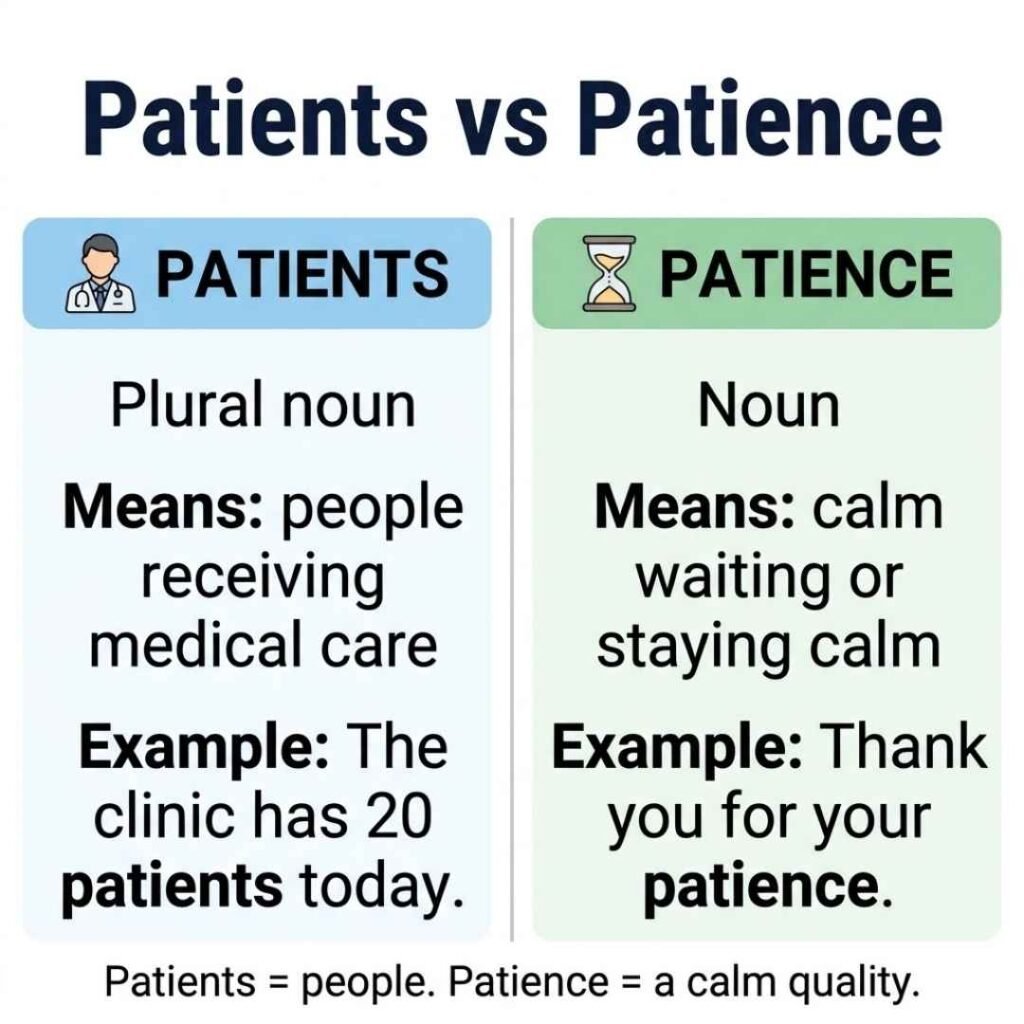
Patience is a noun that means the ability to stay calm while you wait or face trouble. Patients is the plural of patient and means people who receive medical care. Use patience for a calm attitude. Use patients for people in a doctor’s care.
Patients or Patience at a Glance
| Word | Part of speech | Meaning | Example sentence |
|---|---|---|---|
| Patience | Noun | Calm waiting or steady self control | Thank you for your patience. |
| Patients | Plural noun | People receiving medical care | The clinic has 20 patients today. |
| Patient | Adjective | Able to wait calmly | Please be patient. |
| Patient | Noun (one person) | A person receiving medical care | The patient is resting. |
The example sentences in this table were written for this article to show correct use.
What Does Patience Mean?
Patience is a noun. It names a quality, much like kindness or courage. Dictionary.com explains patience as calm perseverance and the ability to stay calm during pain or bad luck.
You can see patience in many small moments. And You show it when you wait in a slow line without getting angry. You show it when you keep working on a hard task instead of quitting. A teacher who explains the same lesson a third time is showing patience too.
Patience is also an abstract noun. That means you cannot touch it or count it. You never write two patiences. You write some patience, a lot of patience or no patience at all.
Patience Takes a Singular Verb
Patience is a single quality, so it takes a singular verb. Write patience is, not patience are. For example, Her patience was impressive. Another example is Patience is hard when you are tired.
A Second Meaning of Patience
In British English, patience can also name a card game played by one person. Americans usually call that game solitaire. This meaning is less common in daily writing, but it explains why you may see the word in a game setting.
What Do Patients Mean?
Patients is the plural of patient. It means people who receive medical care or wait to receive it. You will find patients in hospitals, clinics, dental offices and therapy rooms.
The word points to people, so you can count them. You can have one patient, five patients or three hundred patients. Writers use it in health articles, job ads, office notices and news reports.
Patients Is Always a Plural Noun
Patients is never an adjective. It never describes how someone feels or acts. If you want to describe a calm person, write patient, not patients. For example, The patients are waiting, and they are patient.
Patients’ and Patient’s
An apostrophe shows ownership. For many people in care, write patients’ needs. For one person, write the patient’s chart. The apostrophe does not change the meaning. It only shows who owns something.
Where the Word Patient Fits In
The word patient causes most of the trouble. It plays two roles. It can be a noun for a person under care. And It can also be an adjective for someone who stays calm.
The noun patient has the plural patients. The adjective patient has the noun form patience. That means patient, patients and patience all come from one word family, which is why they look so alike.
Patient as an Adjective
As an adjective, patient describes a person who can wait calmly. Write She is a patient teacher or Please be patient. Notice that the adjective does not end in s.
Patient as a Noun
As a noun, patient names one person receiving care. Write The patient is resting. Add an s only when you mean more than one person.
Here is one sentence that uses all three forms: The nurse thanked her five patients for their patience, because each patient had stayed patient for two hours. This is an example written to show the pattern.
Why People Mix Up These Words
Patients and patience are homophones. Homophones are words that sound alike but differ in meaning and spelling. Grammarly lists the sound of patience as /ˈpeɪ.ʃəns/ and patients as /ˈpeɪ.ʃənts/. The only gap is a small final t sound.
In fast speech, that last t is easy to miss. Dictionary.com points out that the second t in patients is the only audible difference between the two words. A listener may not catch it.
Spelling creates a second problem. Both words are real, so a spell checker will not flag the wrong one. You must check the meaning yourself. Autocorrect can also swap one word for the other without you noticing.
The shared root adds one more layer. Patient is both a noun and an adjective, so writers sometimes carry the s from the noun into the wrong spot. Slow down on this word and read the full sentence before you decide.
Easy Ways to Remember the Difference
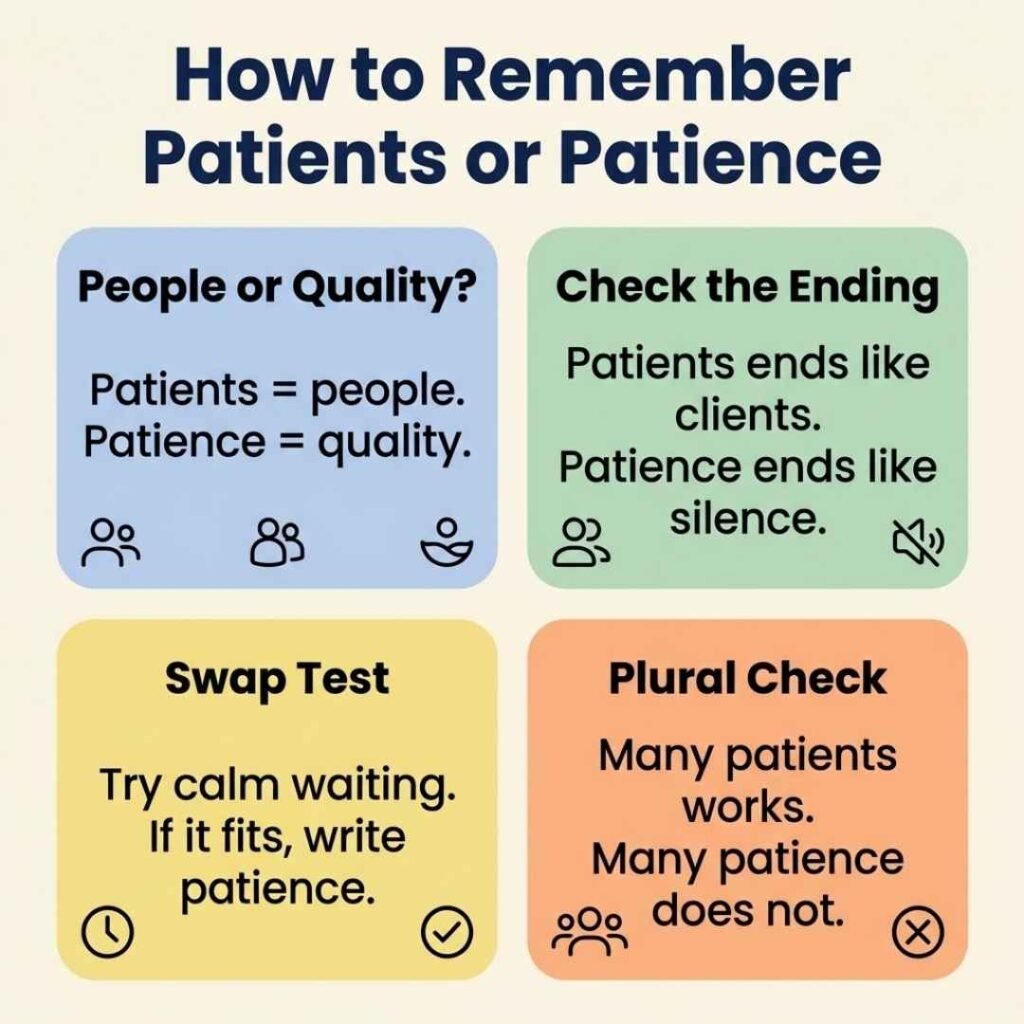
A few simple tricks can lock in the difference. Pick the one that feels natural to you.
Think People Versus Quality
Patients are people. Patience is a quality. If you can picture a person in a hospital bed or a waiting room, you want patients. If you are describing a calm attitude, you want patience.
Compare the Endings
Patients ends with ts, like clients and tourists. Those words name groups of people. Patience ends with ence, like silence and confidence. Those words name states or qualities.
Use the Swap Test
Replace the word with the phrase people receiving care. If the sentence still makes sense, write patients. Now replace it with calm waiting. If that fits better, write patience. For example, Thank you for your calm waiting works, so the right word is patience.
Try the Plural Check
Add the word many in front of the word. Many patients sounds natural. Many patience does not. Only patients passes this test, because patience cannot be counted.
How to Choose the Right Word in a Sentence
Use a quick check with three steps whenever you feel unsure. First, ask whether the sentence is about people or about a quality. Second, run the swap test. Third, check the verb and the number.
Here are three worked examples. In Thank you for your ____, the blank names a quality shown by waiting, so the answer is patience. And In The doctor sees thirty ____ a day, the blank names people, so the answer is patients. In I am losing my ____, the blank names a quality again, so the answer is patience.
Context does most of the work. Look at the words around the blank. Words like thank you, wait, delay, test and run out often point to patience. Words like doctor, nurse, ward, clinic and treatment often point to patients.
Examples in Everyday Life
Every sentence in this section is an example written to show correct use.
In Healthcare
Healthcare writing uses patients most often. A hospital may write, All patients must check in at the front desk. A clinic may post, We are no longer accepting new patients. Staff also need patience, and one sentence can hold both: The nurse showed great patience with anxious patients.
At Work and in Customer Service
In business, patience appears in messages about delays. A company may write, We appreciate your patience while we fix the issue. A manager may say, Please have patience with the new team member. A clinic can use both words in one notice, as in Thank you, patients, for your patience.
At School
Teachers and students talk about patience when learning is hard. A student may say, Learning math takes patience. A teacher may say, I need patience to explain this twice. A nursing student, though, may write about patients in a case study.
At Home
Parents often use patience in daily life. Raising a toddler takes patience. Training a puppy takes patience too. When a family member is ill, the family may talk about the patient and the care that person needs.
Common Phrases With Patience
Patience appears in many everyday phrases. None of them ever use patients, so learning them can help you spot the right spelling.
Lose Patience and Run Out of Patience
When you lose patience, you can no longer stay calm. The phrase run out of patience means the same thing. For example, He ran out of patience after the fourth delay.
Try or Test Someone’s Patience
To try or test someone’s patience means to push their calm to the limit. For example, A noisy room can test a teacher’s patience.
Patience Is a Virtue
This saying tells you that waiting calmly is a good trait. People often say it to encourage someone who feels rushed.
Patience Wears Thin
When patience wears thin, a person is close to losing their calm. For example, Her patience was wearing thin by noon.
Common Mistakes to Avoid
Writing “Thank You for Your Patients”
This is the most common error in emails and signs. It thanks the wrong thing. Patients would mean people under medical care. If you want to thank someone for waiting, write Thank you for your patience.
Writing “Be Patience”
Patience is a noun, so it cannot follow be the way an adjective can. You cannot say Thanks for being patience. You can say Thanks for being patient or Thanks for having patience. Both fixes work.
Using the Wrong Number
Patience is uncountable, so do not write patiences. Patients is countable, so do not write patient when you mean many people. Decide first whether you mean one person, many people or a quality.
Mixing Up the Apostrophes
Patients’ shows ownership by many people. Patient’s shows ownership by one person. Patients with no apostrophe is a plain plural. Patience rarely needs an apostrophe, so check your sentence again if you see one next to this word.
Trusting Spellcheck
Spell checkers read each word alone. They see patients and patience as two correct spellings. A careful read of the full sentence is the only reliable check.
Tricky Sentences With Patient, Patients and Patience
Some sentences use more than one form at once. Slow reading helps. These examples were written for this article.
The patient nurse has patience with every patient. The first patient is an adjective that describes the nurse. Patience is the quality the nurse shows. The last patient is a noun for one person in care.
Of ten patients, only one tests the nurse’s patience. Patients names the group of people. Patience names the calm quality being tested.
Related Words and Synonyms
Synonyms can help you avoid repeating patience. Calm, tolerance, endurance and composure all fit in many sentences. The opposite is impatience, which names the lack of patience. Choose the word that matches the tone of your message.
Patients has fewer direct synonyms, because the word has a specific medical meaning. Related words include clinic, hospital, treatment, nurse and doctor. In nonmedical settings, people may use clients or customers instead. Do not swap those words into a medical sentence unless the setting allows it.
Proofreading Tips
Make one final pass before you publish or send your message. Search your document for the word patients and read each sentence slowly. Ask yourself whether the sentence is about people in care. If not, change it. Then search for patience and confirm each use describes a calm quality.
Signs, emails and social posts deserve extra care. They reach many readers, and a small error can look careless or even funny. A clinic sign that says Thank you, patients, for waiting is correct. A shop sign that says Thank you for your patients is not.
FAQs
What is the difference between patients and patience?
Patients are people receiving medical care. Patience is the ability to stay calm while waiting or facing problems. One names people, and the other names a quality.
Is it “thank you for your patience” or “patients”?
Write “thank you for your patience.” Patients would mean people under medical care, which does not fit a message about waiting.
Are patients and patience homophones?
Yes. They sound almost the same, and the final t is the only audible difference. Their spellings and meanings are different.
Is patience singular or plural?
Patience is singular. It is an uncountable noun, so write “patience is” and not “patience are.”
What does patient mean as an adjective?
As an adjective, patient describes someone who waits calmly or stays calm under stress. As a noun, it names one person receiving care.
Conclusion
Patients are people. Patience is a calm quality. Keep that simple split in mind, and most sentences will fall into place. The words around the blank decide the answer, so read the whole sentence before you choose. When a message is about waiting, use patience. When it is about people in care, use patients.