Many people search for a PlusStories.com review after seeing the name and wondering what the site does. The name sounds like a storytelling app or a tool tied to social media. The real picture is less obvious, and it takes a little checking to see it clearly.
This article explains what independent reviewers and public website checks say about the site. It covers the content, trust signals, pricing, limits and alternatives. It also shows you how to confirm the facts yourself, because website details can change.
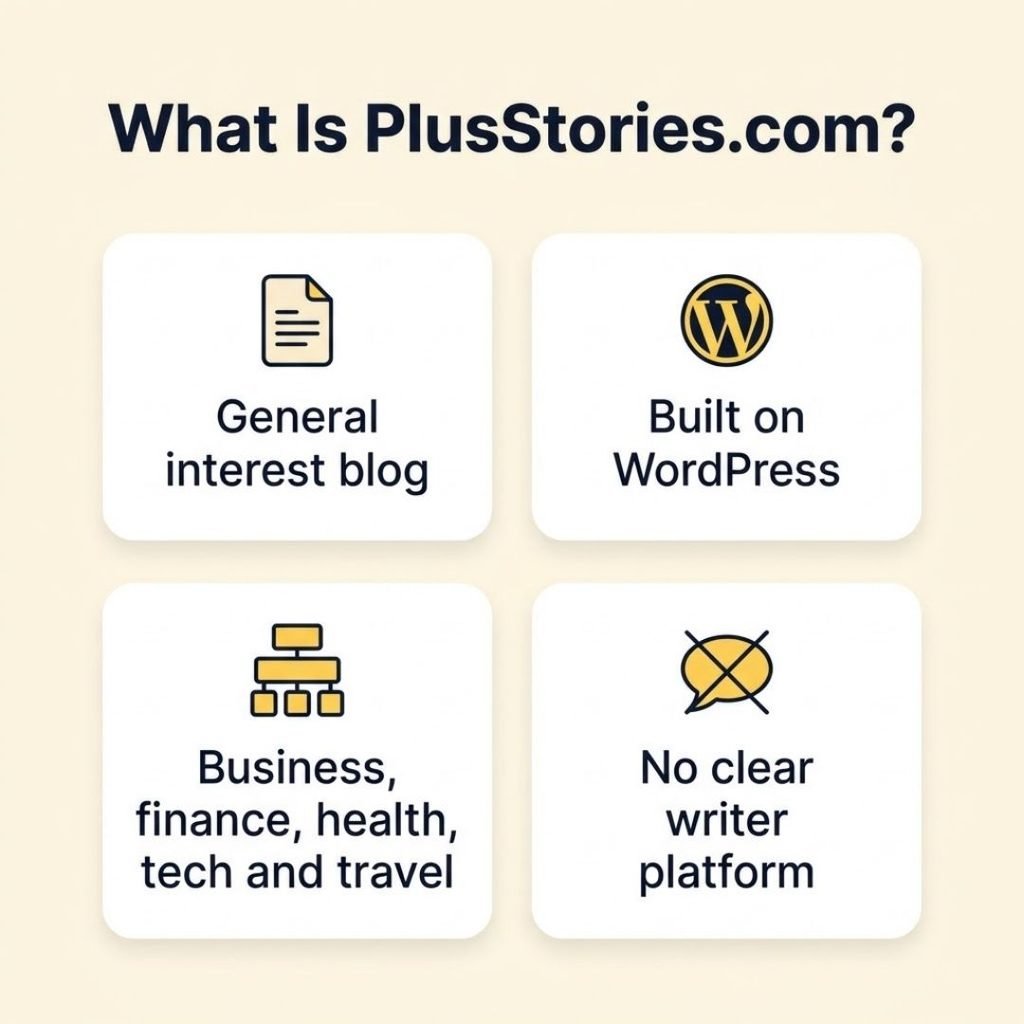
PlusStories.com appears to be a general interest blog built on WordPress. It publishes articles on topics such as business, finance, education, health, technology, travel and lifestyle. Independent reviews say it is not a clear storytelling community, and no source I reviewed proved it is a scam. Some checkers call it low risk, while others point to low traffic and shared hosting. Treat it as a readable blog, not as a writing platform, unless you confirm otherwise.
PlusStories.com Review Table: Key Findings
| What to check | Verified finding | What it means for users |
|---|---|---|
| Site type | General interest WordPress blog, per several reviewers | Expect articles, not a social network |
| Topics | Business, finance, education, health, tech, travel | Wide range, no single specialty |
| Writer tools | No clear public writer dashboard found | Do not assume you can publish there |
| Scam checks | No reviewed source confirmed a scam | Use normal online caution |
| Technical signals | Valid SSL and an older domain reported | Basic safety signs are present |
| Risk notes | Low traffic, shared server and lookalike domains reported | Type the exact address yourself |
| Pricing | No official price page confirmed | Reading looks free; paid claims are unverified |
| Contact details | Standard pages reported; one review found no email | Confirm contact options before sharing data |
This review draws on independent reviews and public scanner reports. It does not claim hands on testing, and each finding reflects what those sources reported at the time.
What Is PlusStories.com?
Several independent reviews describe the same basic picture. PlusStories.com is a content website that covers many subjects instead of one. A review on Pun Prime calls it a general blog built on WordPress with the GeneratePress theme. Other reviewers use similar words, such as content portal or online publication.
That description matters because the name suggests something different. Many readers expect a place to write, post and follow stories. The public pages reviewed so far do not clearly show that kind of system.
Topics You May See
Reviewers list a wide mix of subjects. One review mentions recent posts about AI hallucinations, the gap between artificial intelligence and the human brain, YouTube Shorts management and e-learning tools. Other reviews add finance, health, travel, entertainment and SEO.
This mix is common on small general blogs. It gives the site many entry points from search engines. It also means the site does not stand out as an expert source in any one field.
No Known Link to Instagram Stories
The word “stories” leads some people to think of Instagram. Instagram does offer its own paid plan called Instagram Plus. Reviewers found no evidence that PlusStories.com belongs to Instagram or works as an official Instagram service.
If you want Instagram features, use the Instagram app and its own settings. Do not enter Instagram login details on any outside website.
PlusStories.com Review: How the Site Works for Readers
For a normal visitor, the site works like a blog. You open an article from a category or a search result and read it on the page. Reviewers report that the pages load without a forced sign up. They also report a basic template with a generic layout.
One reviewer saw no aggressive pop ups, redirect chains or forced downloads during the visit. That is a useful sign, yet it only describes one visit at one point in time. Ads, pop ups and layouts can change without notice.
What Readers Can Expect
Readers can expect short to medium articles on everyday topics. Some posts explain tools or trends. Others give general advice on money, learning or lifestyle. The tone is aimed at casual readers, not at professionals.
That fits the way many small content sites work. They target simple questions and give simple answers. This can help a quick search. It is less helpful when you need expert depth.
What Readers Should Not Expect
Do not expect interactive fiction, reader profiles or a writing community. Reviewers did not find a public tool for posting stories. They also did not find a clear feature for following authors or sharing work with a community.
This gap between name and function is the most common point of confusion. It is also the main reason people search for a review in the first place.

Is PlusStories.com a Storytelling Platform?
The evidence points to no, at least in the public view. Pun Prime notes that the homepage copy leans on words like storytelling and voices that matter. Yet the articles on the site read like general blog posts. Reviewers describe this as a mismatch between branding and content.
Not every source agrees. A few promotional articles on other websites describe PlusStories.com as a place where writers can reach an audience with ease. Those articles do not show a signup page, a dashboard or posting rules. Without that proof, the claim is weak.
Could Writers Still Contribute?
A review on Meaning Explain says the evidence does not prove the site accepts outside writers. Another source adds a useful point. Private contributor deals cannot be ruled out, because a site can accept guest posts without a public form.
So the fair conclusion is simple. There is no clear public system for writers. That does not prove the site never works with them.
If you are a writer, ask for written guidelines through the contact page. Ask who owns the work after publication. Ask whether the site pays or charges a fee. Do not send finished work or payment before you have clear answers.
Safety and Trust Signals
Safety is the biggest part of this search. Many readers type the keyword hoping to see a clear safe or scam label. The honest answer is more detailed.
Automated checkers look at technical signals. They do not judge article quality, author skill or business ethics. A high score means the site shows few technical warning signs. It does not prove the content is correct or useful.
Positive Signals Reported
Meaning Explain reports that ScamAdviser rates the domain as very likely safe. The same report lists a valid SSL certificate and a domain registered several years ago. It also notes a safe label from DNSFilter.
Pun Prime reports a clean result from a third party malware and URL scan. The scan flagged no phishing, drive by download or malicious script signs when it ran. Another scanner reportedly found the standard pages in place, including contact, about, privacy and terms pages.
Cautions Reported
The same sources also list cautions. ScamAdviser notes low traffic and a shared server with other sites that earned poor reviews. Another scanner gave the site a medium risk score of 66 out of 100. It also noted that the site has no social media presence.
One review found no direct contact email on the page it captured. Other reviewers saw the standard contact page. This difference could come from timing, page changes or the way each reviewer looked.
None of these points proves harm. They simply show why one score should not decide your view.
Lookalike Domains
Pun Prime flags a risk that deserves attention. It reports near identical sister domains that repeat the same marketing copy, including plusstoriess.com and plusstoriesnews.com.
Lookalike names make mistakes easy. You may land on a copy by a typo or a misleading link. Always check the spelling in your address bar before you read, sign up or share any detail.
Is PlusStories.com a Scam?
No reviewed source confirmed it as a scam. Several reviewers reached the same cautious view. They found a working website, a valid SSL certificate and no proven malicious behavior.
Still, “not confirmed as a scam” is not a promise of safety. The safest approach is to read the site like any unfamiliar blog. Do not download files from it. Do not enter payment or login details unless the checkout and privacy pages are clear.
PlusStories.com Pricing and Cost
Reading public articles appears to be free. Reviewers did not describe a paywall or a required account for normal reading.
Paid access is less clear. One review lists specific prices, while others mention paid options without giving amounts. No reviewer confirmed an official pricing or checkout page. For that reason, you should not treat any price you see in a third party review as current or real.
If you ever see a payment request tied to this name, pause. Look for an official pricing page, a refund policy and a business address. If those are missing, do not pay.
Who May Find PlusStories.com Useful
The site may suit casual readers who want quick answers on general topics. A person curious about AI basics, short video tips or learning tools may find a few useful posts. The articles work best as a starting point, not as a final source.
It may also interest people who study small content sites. Marketers and students can use it as an example of a multi topic blog and how its branding compares with its real content.
Who Should Look Elsewhere
Writers who want a community should look elsewhere. So should readers who want expert medical, legal or financial advice. For those topics, rely on licensed professionals and official sources, and treat a general blog only as background reading.
Anyone who wants interactive stories or social features will also be disappointed. The site does not appear to offer them.
Limitations to Keep in Mind
The first limit is the gap between name and content. A name that promises storytelling and a site that delivers general articles can confuse new visitors.
The second limit is depth. Reviewers describe the site as suited to casual reading, not deep expertise. Broad sites that cover finance, health and technology at once rarely have a specialist for each area.
The third limit is trust data. Traffic is low, social proof is limited and the site shares a server with weaker sites. These are soft signals, yet they explain why some scanners give mixed scores.
The fourth limit is time. Most reviews were published within the past few months. A site can change its content, ownership, layout or monetization quickly. Check the date on any review before you rely on it.
How to Check PlusStories.com Yourself
You do not need special tools to run a basic check. These steps take a few minutes.
- Type the address yourself instead of clicking a link.
- Open the about, contact, privacy and terms pages.
- Check the author name and date on a few articles.
- Compare facts in an article with an official source.
- Run the domain through a public checker such as ScamAdviser.
- Search the exact name to spot lookalike domains.
Keep notes on what you find. If the contact page lists an email address, send a short test message and see whether you get a reply. A real site team usually answers within a reasonable time.
Common Mistakes When Judging Small Websites
The first mistake is trusting the name. A name that sounds like an app does not make a site an app. Always compare the promise with what the pages show.
The second mistake is trusting one score. Safety tools use different data, so they often disagree. A fair view uses several signals together.
The third mistake is trusting old reviews. A review from last year may describe a different site today. Look for dates and compare more than one source.
The fourth mistake is treating promotional posts as proof. Some articles praise a site without showing a feature, a screenshot or a source. If a claim cannot be checked, treat it as an opinion.
Where Reviewers Disagree
Reviews of this site do not match on every point. Some call it a content aggregator with a storytelling label. Others call it a young publication that may grow. A few promotional posts describe a creator platform without showing proof.
The gap comes from method. Some reviewers check technical data only, while others compare the homepage promise with the real pages. When sources disagree, give more weight to findings you can open and test, such as dated pages, visible features and public scan reports. Give less weight to general praise.
Alternatives to PlusStories.com
The best alternative depends on your goal. Each option below serves a different need.
- Medium suits readers and writers who want an open publishing site with author profiles.
- Substack suits people who want to follow writers through email newsletters.
- Wattpad suits fiction readers and new authors who want feedback.
- Instagram suits people who want short visual stories from friends and brands.
For general news and explainers, many readers also use established news sites and library databases. These sources usually list authors, editors and correction policies.
FAQs About PlusStories.com
Is PlusStories.com a real website?
Yes. Reviewers describe a live WordPress blog with many articles across several topics. Its public content appears to be general, not a full storytelling platform.
Is PlusStories.com safe to visit?
Reviewed scans found no confirmed threats, and one checker rated it very likely safe. Still, use normal caution and avoid sharing payment or login details.
Can I publish my stories on PlusStories.com?
No public writer system was clearly found. Ask the site for written guidelines before you send any work or money.
Is PlusStories.com connected to Instagram Stories?
Reviewers found no evidence of a link. Instagram offers its own paid plan, and it works separately from this website.
Conclusion
PlusStories.com looks like a general interest blog, not a social storytelling platform. The reviewed evidence shows a working site with some positive technical signs and some soft warnings. No source proved it is a scam, and none proved it is fully trustworthy.
Casual readers may find it useful for quick background reading. Writers, buyers and anyone sharing personal data should verify the contact details, pricing and rules first. Check the spelling of the address, and treat any big claim as unverified until you see proof.