Is it adviser or advisor? You can find both spellings in news stories, job titles and school emails, so it is easy to wonder whether one of them is wrong. If you searched for advisers vs advisors and what the difference is, the short answer comes first below.
This guide then shows where each spelling appears and what major style guides say. It also explains how to choose the right one for finance, school and work.
Adviser vs Advisor
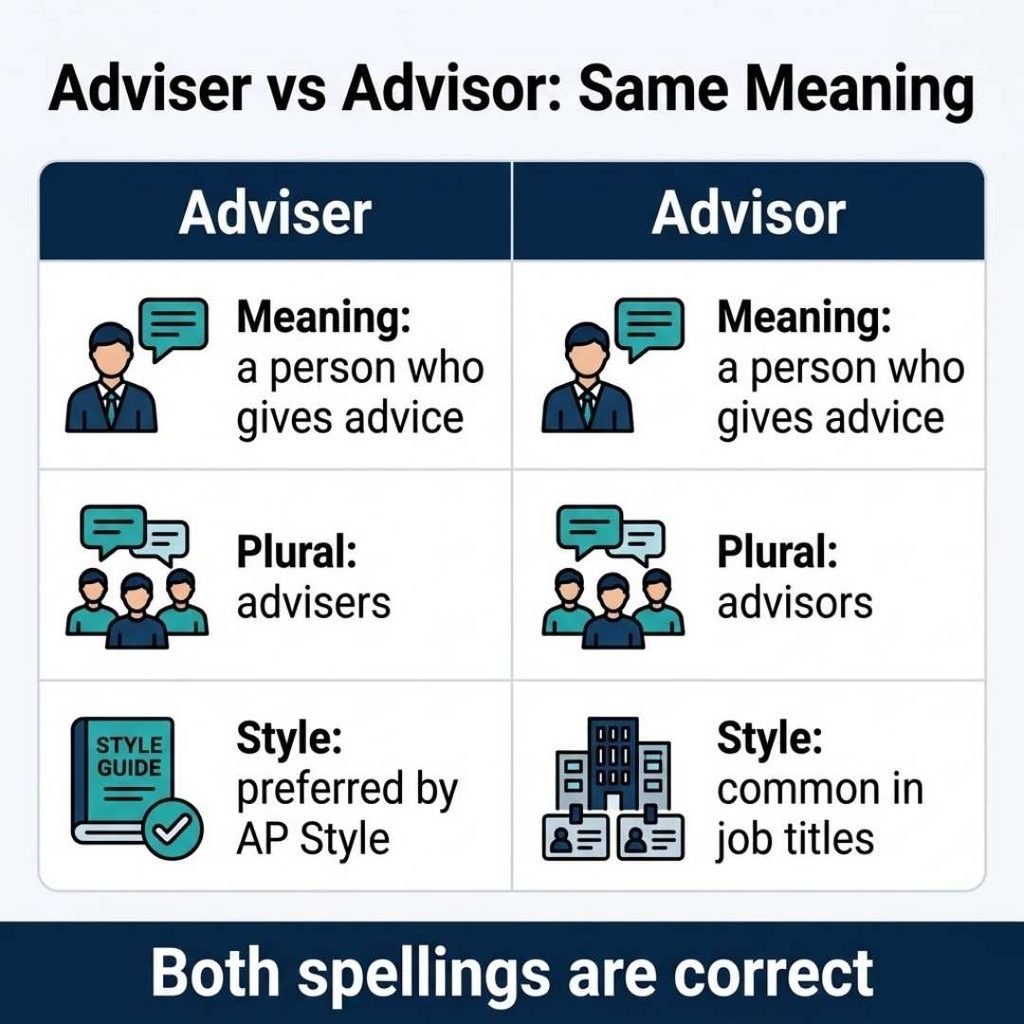
There is no difference in meaning. Adviser and advisor are two accepted spellings of the same word for a person who gives advice. Merriam-Webster treats both as correct. AP Style prefers adviser, and many job titles use advisor. Pick the spelling your style guide or official title uses, then stay consistent.
Adviser vs Advisor at a Glance
Use this table for a fast comparison.
| Topic | Adviser | Advisor | Takeaway |
|---|---|---|---|
| Meaning | Person who gives advice | Same meaning | No difference |
| AP Style | Preferred | Not preferred | Use adviser in news writing |
| Dictionary | Full entry | Variant of adviser | Both are correct |
| US investment law | Spelling in the 1940 Act | Common in job titles | Copy the official name |
| Plural | Advisers | Advisors | Match your singular |
What Is the Difference Between Advisers and Advisors?
The two words mean the same thing: people who give advice. The only difference is spelling. AP Style prefers adviser, and advisor often appears in official job titles. Both are correct when you use one spelling consistently within the same piece of writing.
Merriam-Webster defines an adviser as someone who gives advice and lists advisor as a variant. It also says both spellings are correct, whatever your spellcheck suggests.
So a reader will not see a change in meaning if you swap one for the other. A reader is more likely to notice the spelling if you switch back and forth in one article.
What Is the Plural of Adviser and Advisor?
Add an s to the spelling you chose. Adviser becomes advisers. Advisor becomes advisors. Keep the same spelling in the singular and the plural.
Is Advisor More Formal Than Adviser?
Some writers think so. Scribbr says advisor usually signals an official position. Merriam-Webster notes that advisor tends to appear with official roles, such as an advisor to a president. These are patterns in usage and not rules. Neither spelling is wrong.
What Does an Adviser or Advisor Do?
An adviser gives advice, recommendations or guidance to a person or group. The adviser does not make the final choice. The person who asks for help does.
The role shows up in many places. An academic advisor helps students plan their courses. A financial adviser explains money choices, such as saving or investing. A faculty advisor supports a student club. A political adviser guides an elected leader. The person who receives the advice is sometimes called an advisee.
Several nearby words are easy to mix up. A mentor usually offers personal guidance over a longer time. A consultant is often hired for expert help on a specific project. A counselor may offer support on personal or school matters. These roles can overlap, so the job title and context tell you more than the word alone.
Related words follow their own rules. Advice is a noun, as in “She gave me good advice.” Advise is a verb, as in “She will advise me.” Advisory is an adjective or a noun, as in a travel advisory. It ends in ory, and it has no other spelling.
Adviser and Advisor in a Sentence
These examples are made up. Either spelling works in each one, and the meaning stays the same.
- School: “My academic advisor signed my course form.”
- Research: “Her thesis adviser read the draft twice.”
- Business: “The company hired a marketing adviser for the launch.”
- Government: “The mayor named a new housing advisor.”
- Finance: “Our financial adviser explained the fees.”
- Clubs: “The faculty advisor leads the chess club.”
- Teams: “The panel included three advisors from different fields.”
- Writing: “Her editor served as an adviser on the memoir.”
In each case, one person offers guidance and another person decides what to do. The spelling changes how the word looks. It does not change what the word does.
Where Do Adviser and Advisor Come From?
English uses both er and or to name a person who does something. Writers use er in words like teacher and reader. They use or in words like actor and supervisor. Both endings are normal, which helps explain why this word has two spellings. In speech, the two forms usually sound the same, so the difference only shows up on the page.
Merriam-Webster dates the first known use of adviser to around 1536. Scribbr calls adviser the original spelling. A University of Notre Dame editor’s note adds that Google’s Ngram data shows adviser as the historic leader, with advisor overtaking it in recent years.
Sources do not fully agree on which spelling is more common today. So popularity alone is a weak guide. We also did not find a reliable source that gives a date for the first use of advisor, so this article does not state one.
Which Style Guides Prefer Adviser or Advisor?
Style guides settle this question for many writers. Here is how a few of them lean.
- AP Stylebook: adviser
- Merriam-Webster: both spellings are correct
- University of Notre Dame style guide: adviser, except advisor in a full job title before a name
- Kiplinger’s Personal Finance: adviser, except in proper nouns
Many newsrooms follow AP, so adviser is common in news writing. The Notre Dame pattern is a good model. Use your house spelling in regular sentences. Keep an official title exactly as written.
If you write for a school, publication or company, ask for its style sheet. If you write on your own, choose one form and keep it.
Adviser or Advisor in Finance
In US finance, federal law uses adviser, yet many professionals write advisor in their titles. The spelling does not decide who must register or follow investment rules. What a person does decides that.
The Investment Advisers Act of 1940 uses the e spelling. A staff guide from the SEC explains that Section 202(a)(11) of the Act defines an investment adviser. It also says a person must meet all three elements of that definition to fall under it. Official terms such as Registered Investment Adviser and Investment Adviser Representative come from this system.
Practice in the industry is more mixed. The trade publication InvestmentNews switched to advisor after 26 years, saying the change matched common usage in its field. Kiplinger, on the other hand, keeps adviser in its own writing.
Kiplinger’s explainer also says that a person who gives ongoing investment advice for pay must register as an investment adviser, whatever spelling appears in a title. Registration has exceptions and thresholds, so this article does not cover the details.
Some professionals are brokers and not investment advisers. The two groups register with different bodies, and a title alone does not tell you which one a person is. You can check each group in a public database. The SEC’s Investment Adviser Public Disclosure site covers advisers, and FINRA’s BrokerCheck covers brokers.
So do not judge a professional by the letter e or o. Check their registration and disclosures instead. If you write about a firm, copy the spelling from its legal name. This article covers spelling only. It is not legal or financial advice.
Adviser or Advisor in School and Work
Schools and workplaces use both spellings. Scribbr says both are fine for a college adviser and a PhD adviser. Merriam-Webster even shows thesis advisor in one of its example sentences. Real usage is mixed.
Use your school or company style in normal sentences. Then keep the exact spelling from any official title. If a professor signs emails as Faculty Advisor, write Faculty Advisor when you name that title. A change can look like a typo to that person.
In education, you may see terms such as academic advisor, faculty adviser, career advisor and thesis adviser. They describe different jobs and not different spellings. Ask the department which form it uses on official forms, then copy it into emails and documents that name the role.
The same rule applies to groups. A company or nonprofit may form a board of advisors or an advisory board. Use the spelling the group itself uses in its name.
Resumes work the same way. List your title as it appears in your contract or on your employer’s records. If you are unsure, ask your human resources team which spelling the company uses.
How Do You Capitalize Adviser and Advisor in a Title?
Many style guides capitalize a formal title when it comes right before a name and use lowercase after it. Check your own style guide, because rules differ. The spelling stays the same either way.
- Before a name: “Academic Advisor Maria Lopez will meet you at noon.”
- After a name: “Maria Lopez, an academic advisor, will meet you at noon.”
- Without a name: “Please email your academic advisor.”
The name in these examples is made up.
Is Advisor More Common in the US and Adviser in the UK?
Some sources say so. Scribbr says advisor is more common in US English than in UK English. A financial marketing agency also calls advisor the more common US spelling. Even so, Notre Dame is a US university that prefers adviser. US writers do not all agree.
UK readers may find adviser more familiar. Still, none of the sources we checked call advisor wrong in either region. Treat region as a hint and not as a rule.
How to Choose Between Adviser and Advisor
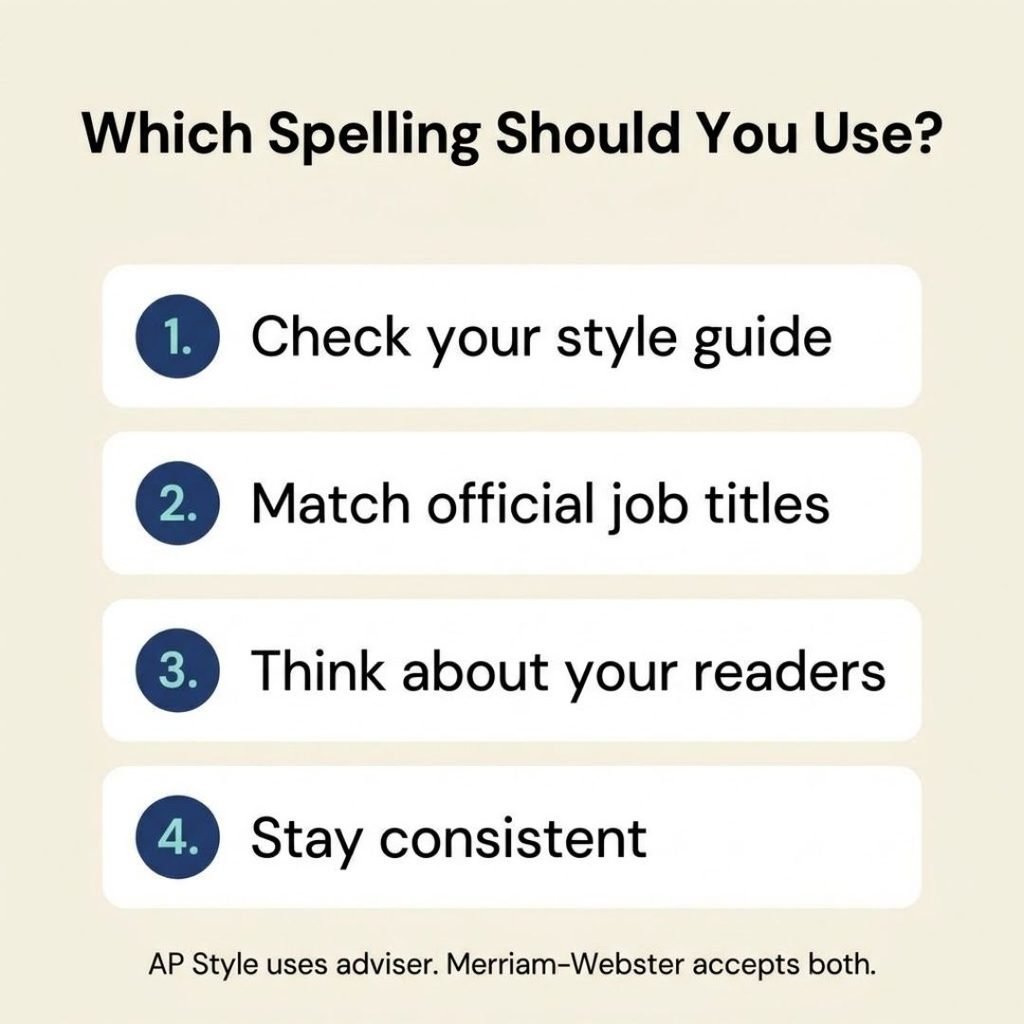
Follow these four steps in order.
- Check the style guide. If your school, client or publication has one, follow it. AP Style says adviser.
- Match official names. Copy job titles, company names and legal terms as the owner writes them.
- Think about your readers. If your audience mostly uses one spelling, that choice may feel more natural.
- Stay consistent. Use the same spelling from the first paragraph to the last.
Consistency matters most. Readers accept either spelling, but a mix in one article can look careless. If several people write for one project, add a line to a short style sheet so everyone follows the same choice.
Here is a worked example. Suppose you write a company blog post about your financial planning team. Your firm’s registered name uses Adviser, but your team members’ titles say Financial Advisor. Use adviser in your regular sentences if that is your house style. Copy each title exactly as it appears. That keeps your writing consistent and accurate.
Which Spelling Should You Use in Common Situations?
Your own style guide always comes first. Use this list as a quick lookup.
- News article or press release: adviser, if you follow AP Style
- Company website or email signature: the spelling in your official title
- Academic paper or thesis: the spelling your school or journal style uses
- Resume or LinkedIn profile: the spelling in your employer’s records
- Legal or financial filing: the exact spelling in the firm’s registered name
- Personal writing or a blog: either one, used consistently
Before you publish, search your draft for both spellings. Most word processors have a find tool that does this in seconds. Leave proper names and quoted titles alone. Do not rely on spellcheck, because it may accept either form and will not catch a mix.
Which Spelling Should a Website or Blog Use?
People search with both spellings, so website owners often wonder whether one ranks better. A financial marketing agency advises writers to focus on useful content and relevant keywords and not to worry about this spelling. That advice makes sense.
Write the way your audience writes and choose one main spelling for your titles and body text. You can mention the other form once in a natural way, such as “an adviser, also spelled advisor.” That helps readers who arrive with the other spelling in mind. A clear and honest answer matters more than one letter.
Common Mistakes to Avoid
A few small errors appear again and again.
Mixing both spellings in one article. This is the most common slip. Search your draft and fix any mismatch.
Rewriting an official name. If a firm calls itself a Registered Investment Adviser, do not change it to Advisor. Proper names stay as the owner wrote them.
Treating one spelling as an error. Both are correct, so change someone else’s spelling only to match a style guide.
Changing a direct quote. Keep the spelling inside a quotation exactly as the speaker or source wrote it, even if it differs from your house style.
Reading a title spelling as a legal signal. The letter e or o does not show whether a financial professional is registered. Check the public records instead.
FAQs
Is it adviser or advisor?
Both are correct. They are two spellings of the same word. Choose one and use it consistently.
Does AP Style use adviser or advisor?
AP Style uses adviser. Other sources, such as Merriam-Webster, list both spellings as correct.
Which spelling is correct in the UK?
Both are accepted. Scribbr says advisor is less common in UK English than in US English, but none of the sources we checked call it wrong.
Should I use adviser or advisor on a resume?
Use the exact spelling from your job title or contract. For general writing, follow the style guide of the employer or the application.
Does the spelling of a financial advisor’s title matter legally?
US law uses adviser, but spelling a title either way does not change whether someone must register. Their activities matter more.
Conclusion
Advisers and advisors mean the same thing. Your choice comes down to a style guide, an official title or a house preference.
Follow the rules of the place where you publish and keep official names as written. Then use one spelling from start to finish. If you are ever unsure, ask what the publication or employer uses and match it.